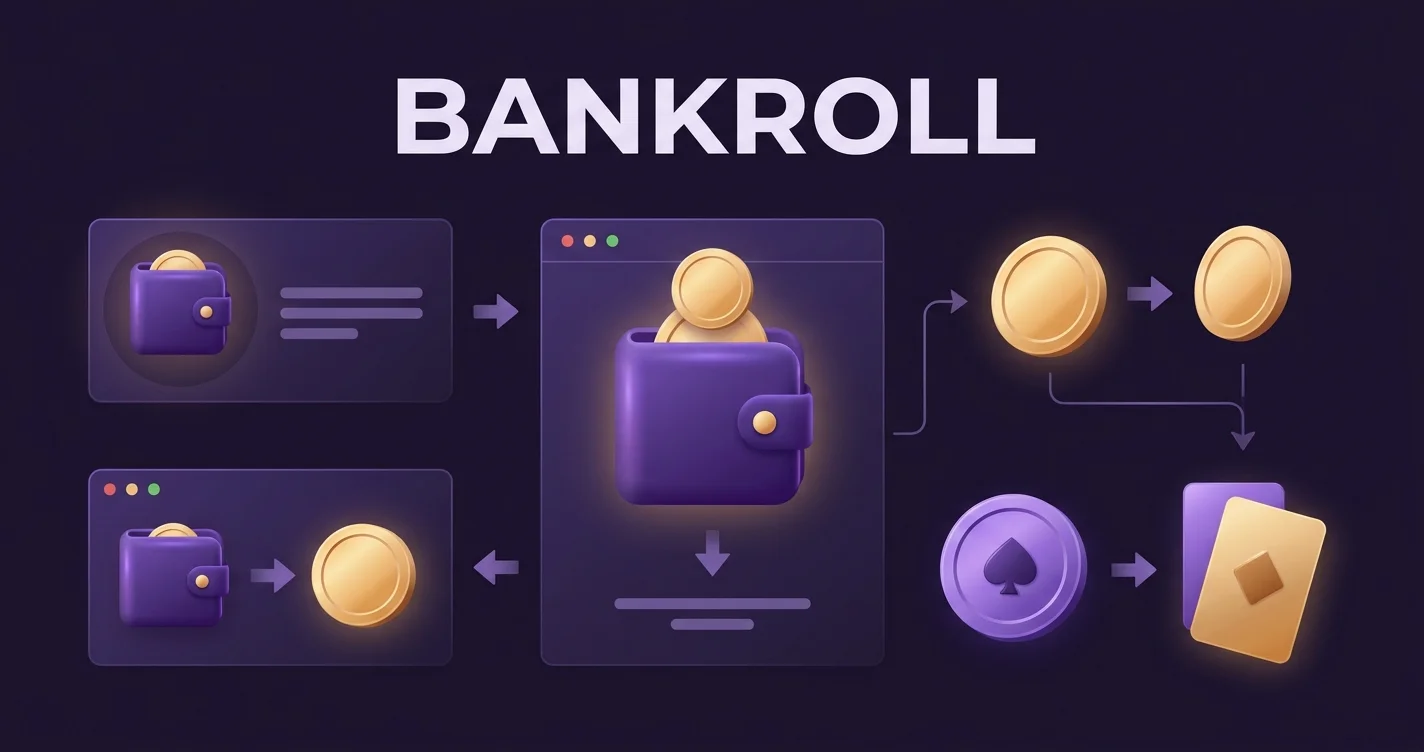
A bankroll is the amount of money you have deliberately set aside for gambling and are prepared to lose completely without harming your life. It isn't the whole balance on your card, and it isn't money for rent or food. It is a separate "gambling budget." Its size determines your bet, how long you can play, and the risk of burning through everything quickly.
What counts as part of a bankroll and what doesn't
The easiest way to think of a bankroll is as a separate wallet for entertainment. It holds only money whose loss won't change your plans for the month.
Included:
- the sum you set aside for gambling in advance;
- winnings you left on your gaming balance and keep playing with;
- money you add according to a plan (for example, a fixed amount per month).
Not included:
- money for utilities, food, transport, tuition;
- borrowed funds and loans from friends;
- savings set aside for a specific goal;
- money you "topped up" after your bankroll ran out.
The last point is the most important. If the bankroll is gone, gambling is over for today (or for this month). A new deposit "to win it back" is no longer a bankroll, it's a breach of your own rules.
Why you need one
Gambling is built mathematically so that over the long run the casino keeps a small advantage. You can read more in the article on the house edge. A bankroll doesn't change that math, but it gives you three practical things:
- A loss limit. You know in advance the most you can lose.
- Control over bet size. Your bet is calculated from a sum, not from your mood.
- Calmer decisions. When the money isn't critical, there's less temptation to jump into a bad idea on emotion.
A bankroll doesn't guarantee a win. It only helps you play longer and stay within your limits.
How to determine your bankroll size
There is no universal figure. Don't start with the question "how much do I want to win," but with "how much can I afford to spend on entertainment." The benchmark is the same as for a cinema ticket or dinner at a café: money you won't regret spending.
Practical steps:
- Work out your monthly sum after all essential expenses.
- Set aside part of it for gambling. If you're unsure, take the smaller amount.
- Write this sum down as your bankroll and don't raise it mid-month.
- Split it into sessions (more on this below).
If the bankroll then feels "too small for interesting play," that's normal. In that case your bets should be smaller, not your bankroll bigger.
Bet size and the "bet unit"
Players often calculate their bet as a percentage of the bankroll. One such bet is called a unit. A conservative approach is 0.5% to 2% of the bankroll per spin or round. This is neither a rule nor a guarantee, just a way not to run out of money in a few minutes.
Take a bankroll of 2000 UAH and see how many bets it lasts, assuming the worst case (no wins at all):
| Bet | Share of bankroll | Spins to zero with no wins |
|---|---|---|
| 10 UAH | 0.5% | 200 |
| 20 UAH | 1% | 100 |
| 50 UAH | 2.5% | 40 |
| 100 UAH | 5% | 20 |
This is an upper limit, not a forecast: in real play some of your bets come back as wins, so a session usually lasts longer. But the table clearly shows how quickly risk grows with "big" bets.
An example with expected losses
Suppose you play a slot with an RTP of 96% at a 20 UAH bet. Over 100 spins the turnover is 2000 UAH. The average expected loss is 4% of turnover, or about 80 UAH. That's 0.8 UAH per spin.
Important: this is an average over a very long run. Over 100 spins the real result can be minus 600 UAH or plus 400 UAH. Short sessions depend on variance far more than on RTP. That's why a bet of 1% of the bankroll gives you a safety margin for a "bad" streak, while a 5% bet leaves much less of it.
Bankroll and volatility
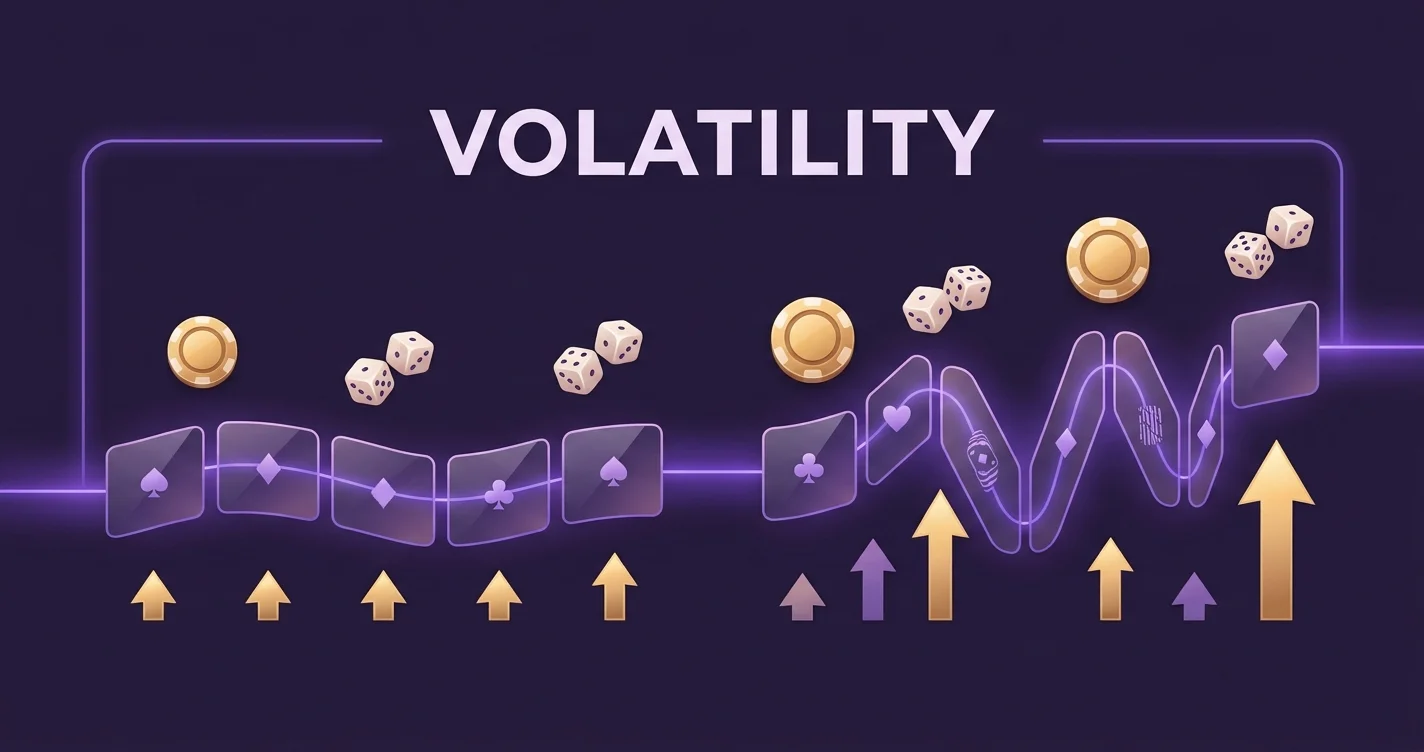
Your bankroll size should be matched to a game's volatility. It shows how unevenly a game pays out.
- Low volatility: wins are small and frequent, and the balance changes smoothly. A smaller bankroll is enough for a session.
- High volatility: long streaks without wins and rare big payouts. You need a smaller bet or a larger bankroll to survive the "dry" stretches.
If your bankroll is small and you play high volatility with a big bet, it's quite likely your balance will hit zero before a strong streak arrives. That isn't "bad luck," it's normal behavior for such games.
Session bankroll: splitting the sum into parts
A separate technique is dividing your bankroll into sessions. It protects you from the "lost everything in one evening" scenario.
Example: a monthly bankroll of 2000 UAH is split into 4 sessions of 500 UAH. For each session you set two rules:
- Loss limit: if the session's 500 UAH is gone, you stop playing until the next session.
- Target or time: for example, stop if the balance rises by a certain amount, or after 30-40 minutes of play.
A loss limit works better than a win target because it's easier to stick to. If you've won and want to continue, the decision to "withdraw part and play only with the rest" is also good practice.
Bonuses and your bankroll
Bonus funds and free spins shouldn't be treated as part of your bankroll on equal terms. They come with conditions, including a wagering requirement, meaning the volume of bets you must place before withdrawing. A hypothetical example: a 500 UAH bonus with x20 wagering means 10,000 UAH of turnover. At a 25 UAH bet that's 400 spins. If your bankroll and bet aren't sized for that volume, the bonus will create pressure rather than help.
So before activating one, check the terms: wagering, expiry period, eligible games. RichTop offers a welcome package, cashback, rakeback and a daily bonus, but each has its own rules worth reading separately. Cashback, for example, returns part of your losses, but it isn't insurance and isn't a reason to raise your bets. Plan your bankroll as if cashback didn't exist, and if it arrives, treat it as a pleasant extra.
The same applies to free spins: they don't increase your real bankroll until the winnings from them have been wagered according to the terms.
Common mistakes
- Playing with "everything on the card." A bankroll must be defined in advance, not equal whatever is left in your account.
- Raising your bet after a loss. This speeds up the loss of your bankroll and increases risk.
- Topping up again and again "to win it back." Chasing losses is the most common trap. Lost money is already lost, and the next spins don't "owe" you a win.
- Estimating bets by eye. If you don't know your bet as a percentage of your bankroll, you aren't managing risk.
- Mixing your bankroll with a bonus balance. A bonus with wagering and your own money are different things.
- Not recording results. Simple notes on the amount deposited and the amount left help you see the overall picture soberly.
- Ignoring fatigue and emotions. After a loss, decisions are usually worse.
Bankroll myths
"A big bankroll guarantees a win"
No. A bigger bankroll gives you more spins and absorbs losing streaks more gently, but the casino's mathematical edge remains. You simply play for longer.
"The Martingale will protect your bankroll"
The system of doubling your bet after a loss looks logical until you do the math. Start with a 10 UAH bet: 10, 20, 40, 80, 160, 320, 640. After seven losses in a row you've already lost 1270 UAH, and the next bet under the system must be 1280 UAH. From a 2000 UAH bankroll you'd have only 730 UAH left, so continuing the scheme is impossible. In other words, one streak of seven losses takes more than 60% of your bankroll, while a win at any step brings only the original 10 UAH. On top of that, games have maximum bet limits that can break the doubling even earlier. Such a system trades a small profit for the risk of a big loss.
"After a long losing streak, the game has to pay back"
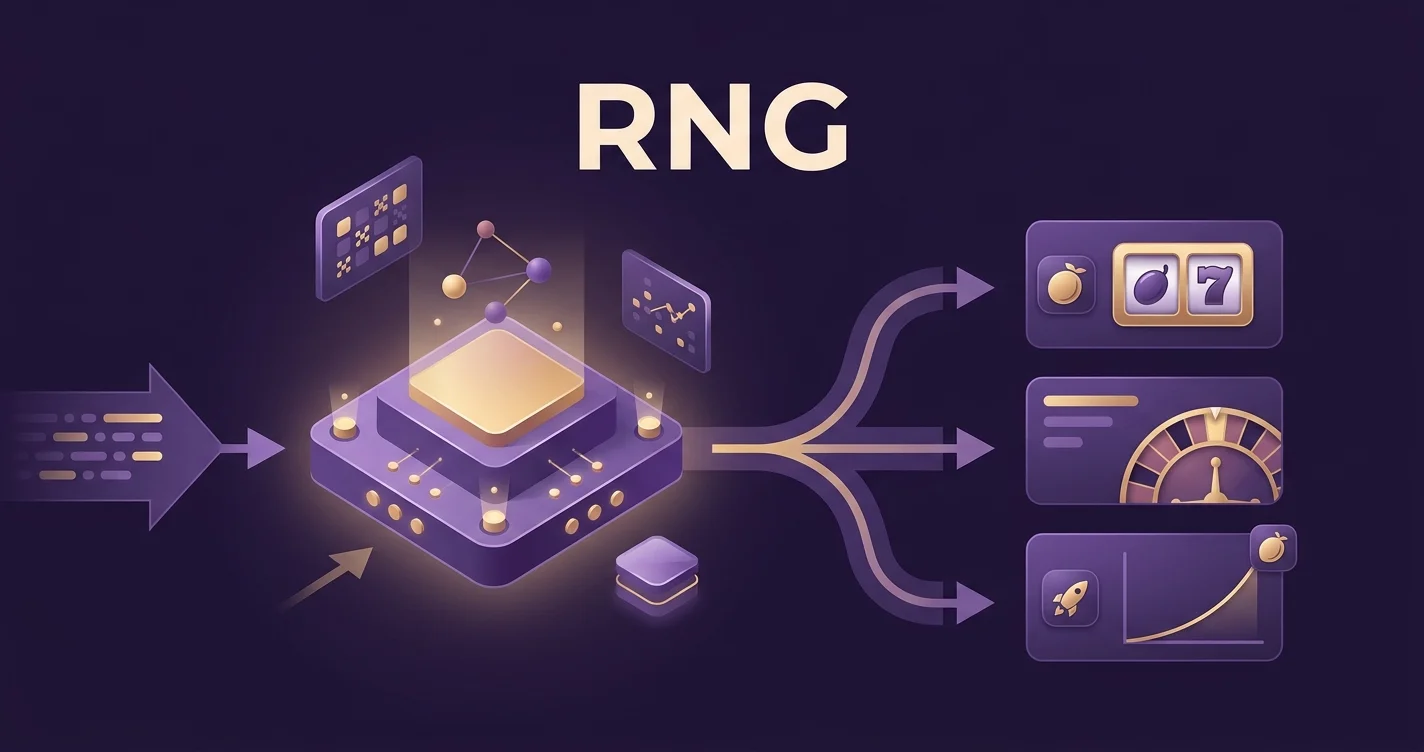
Every spin in a slot is independent of the previous ones. The random number generator doesn't "remember" your streak. Metrics such as hit rate describe the game as a whole; they don't tell you when it will "pay back."
"Proper bankroll management turns gambling into income"
Bankroll management controls spending, but it doesn't create a positive expectation. Gambling is entertainment you pay for, not a source of income.
How a bankroll affects your decisions
- Choosing a game: a small bankroll is best paired with low or medium volatility and a small bet.
- Choosing a bet: 0.5% to 2% of the bankroll leaves a margin for bad streaks.
- Choosing a bonus: if the wagering requires turnover beyond your means, it's better to decline.
- Discipline: a limit set in advance replaces decisions made "on emotion."
- Expensive features: buying a bonus at a multiple of your bet eats a bankroll very quickly. Read about it in the article on the bonus buy.
Deposits and withdrawals within your bankroll
Top up your account with exactly the amount that fits your plan. At Rich Top the minimum deposit is from 300 UAH via P2P transfer, from 500 UAH by card and from 5 USDT in crypto, but these are only technical minimums, not a recommendation. Your deposit size is set by your bankroll, not by the minimum amount on the site.
Winnings you've decided to take are better withdrawn than left on your balance "for the next game." That way you clearly separate bankroll money from money that has already become yours.
Responsible gambling
Gambling is available only from age 18. Play only with money you can afford to lose, and don't treat a casino as a way to solve financial problems. Signs that it's time to stop: you bet more than planned, hide your spending, borrow to gamble or can't stop after a loss.
Rich Top lets you limit yourself: there is self-exclusion for a period from 6 months to 5 years, as well as tips on controlling your play and contacts of organizations where you can get help. Set a limit in advance, while your mood is calm.
A quick checklist
- Decide on a sum you can afford to lose and write it down as your bankroll.
- Split the bankroll into sessions.
- Limit your bet to roughly 0.5-2% of the bankroll.
- Choose games by volatility to match your bankroll size.
- Set a loss limit per session and stick to it.
- Read bonus terms, and don't confuse bonuses with your own money.
- Don't top up your account to win back losses.
A bankroll doesn't make gambling profitable, but it helps keep it entertaining and safe for your budget.




 Google

 Payment History