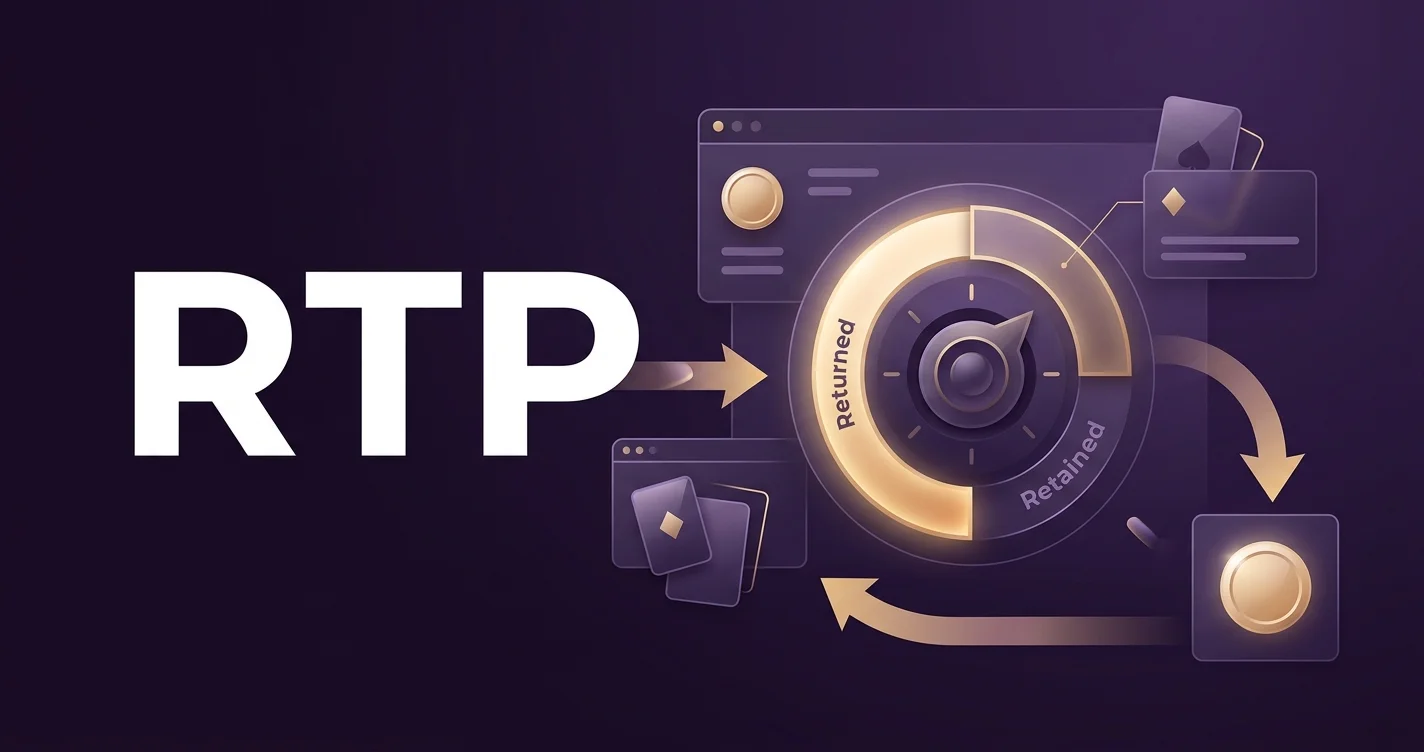
RTP (Return to Player) is the theoretical percentage of wagers a game returns to players over a very long run. If a slot has an RTP of 96%, then on average, out of every 100 UAH wagered, 96 UAH is paid back in winnings and 4 UAH stays with the casino. This is a statistical average, not a promise for your session.
How RTP works
RTP is calculated from the game's mathematical model: all the symbols, their combinations, the probabilities of landing them, the bonus features and the payouts. The result shows how much the game pays back on average over an enormous number of spins, meaning millions and more.
The formula is simple:
- RTP = total player winnings / total wagers × 100%
- House edge = 100% − RTP
In other words, with an RTP of 96% the house edge is 4%. This is not profit from each of your spins. It is an average figure that results only approach over a very long run.
What RTP includes
RTP covers all of the game's payouts, not just the simple combinations on the main screen. This includes:
- wins in the base game;
- payouts for scatters and the bonus rounds they trigger;
- free spins, multipliers and additional features;
- the jackpot, if it is part of the game (depends on the specific model).
That is why two slots with the same RTP can feel completely different: in one, wins are small and frequent, in the other they are rare but large. The metric responsible for this is volatility.
An example with simple numbers
Suppose a slot has an RTP of 96% and you bet 10 UAH.
- You make 1,000 spins at 10 UAH each. Total turnover of bets: 10,000 UAH.
- Theoretical return: 10,000 × 0.96 = 9,600 UAH.
- Expected loss: 10,000 − 9,600 = 400 UAH.
This is a mathematical expectation, not a forecast. The actual result can differ greatly. You can end up in profit, or you can lose your entire bankroll in 100 spins. The shorter the session, the wider the spread around the average.
Comparing different RTPs
Here is what the expected loss looks like with a bet turnover of 10,000 UAH:
| RTP | House edge | Theoretical return | Expected loss |
|---|---|---|---|
| 94% | 6% | 9,400 UAH | 600 UAH |
| 96% | 4% | 9,600 UAH | 400 UAH |
| 98% | 2% | 9,800 UAH | 200 UAH |
A difference of 2 percentage points looks small, but over long play it means a theoretical loss that is twice as large. So, all other things being equal, a higher RTP is better for the player.
RTP, volatility and variance: what's the difference
These concepts are often confused.
- RTP shows how much the game returns on average over the long run.
- Volatility (variance) shows how the wins are distributed: frequent and small, or rare and large.
A slot with 96% RTP and low volatility will give many small payouts and a smooth balance trend. A slot with the same RTP and high volatility can stay quiet for a long time and then deliver a big payout. The average is the same, but the feel of the game is different.
The practical takeaway: RTP helps you assess the long-term cost of playing, while volatility helps you choose a game that suits your bankroll and temperament.
Where to find a game's RTP
RTP is usually listed in the information or rules section inside the game itself (the "i" icon, the menu, the help screen). The developer also often publishes it.
There is one important detail: some games exist in several versions with different RTPs, and the operator chooses which one to connect. So a figure from a review or an overview does not always match the one on your site. The most reliable source is the help section of the game you have opened. For slots at Rich Top, as anywhere else, it is worth checking the figure there before you start playing.
How RTP affects your decisions
Choosing a game
If you play for entertainment and want your budget to be spent more slowly, look at a higher RTP and suitable volatility. The difference between 94% and 97% is noticeable in your wallet over long play.
Bonuses and wagering
RTP is closely tied to bonus wagering. A wagering requirement is a multiplier by which you must roll over a bonus (or a bonus plus deposit) in order to withdraw funds. A hypothetical example:
- a 100 UAH bonus with a x20 wagering requirement, meaning you need to place bets totaling 2,000 UAH;
- at an RTP of 96%, the expected loss on this turnover is 2,000 × 0.04 = 80 UAH;
- so out of the 100 UAH bonus, roughly 20 UAH of value theoretically remains.
These are illustrative numbers to explain the principle, not the terms of a specific promotion. The conclusions are as follows: the higher the wagering requirement and the lower the RTP, the less real value the bonus has. Games also often contribute differently toward wagering, so read the terms of the specific offer. How wagering is calculated at RichTop is covered in a separate explainer article on wagering requirements.
Buying a bonus
In slots with a bonus buy feature, the RTP when buying the bonus may differ from the RTP of regular play, though not always. Check the figure in the game's help section. Also keep in mind that buying a bonus sharply increases the stake for a single "round", and therefore the spread of results.
Common mistakes and myths
Myth 1. "An RTP of 96% means I'll get back 96% in a session"
No. It is a long-term average over millions of spins. In a single session the result can be anything, from a total loss to a significant win.
Myth 2. "The slot hasn't paid out for a long time, so it will soon"
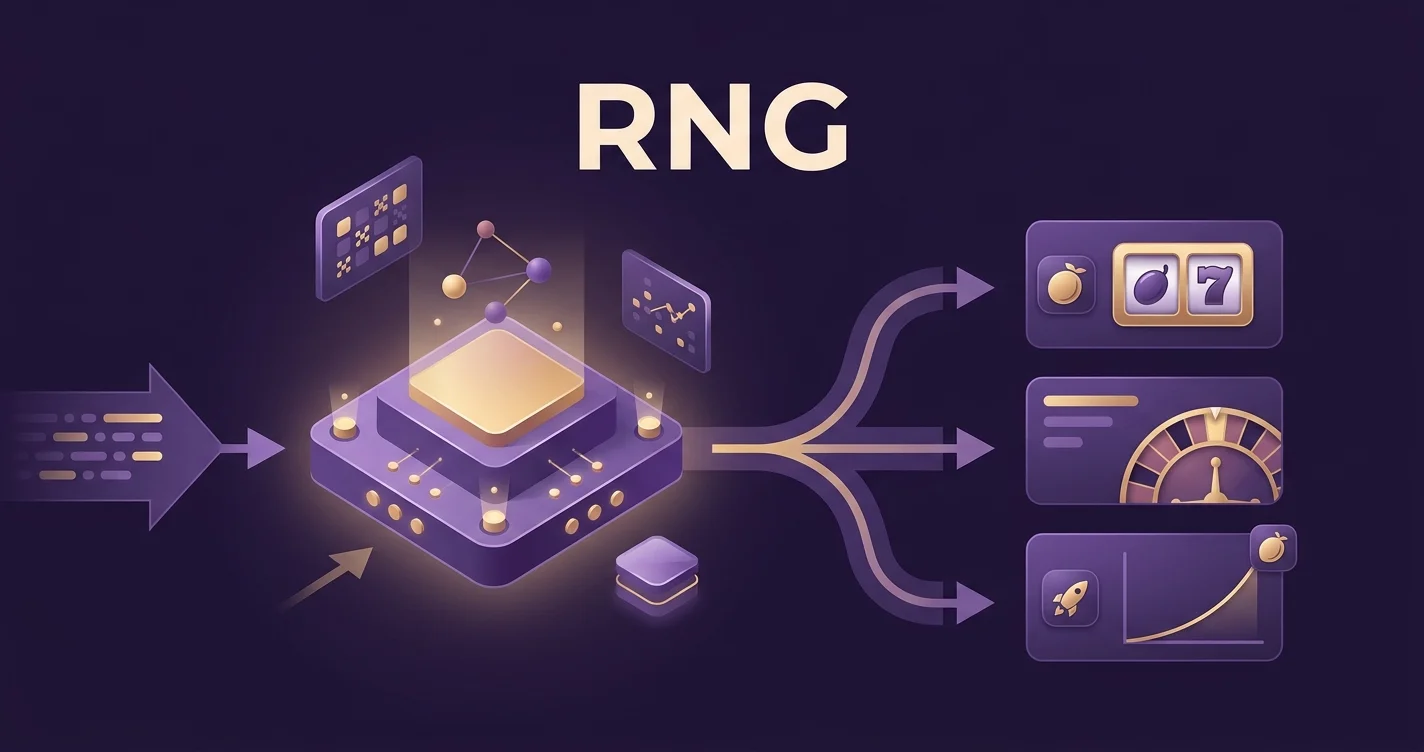
Every spin is independent. The random number generator does not "remember" previous results and does not compensate for a losing streak. The idea that a slot "catches up" to its RTP is false.
Myth 3. "A high RTP means wins will be frequent"
Win frequency depends on volatility, not just RTP. A game with a high RTP can be very volatile.
Myth 4. "You can work out a good time to play"
The time of day, bet size, or "hot" and "cold" slots do not change the built-in RTP. The result is determined by randomness.
Myth 5. "RTP guarantees the casino a profit from every player"
RTP describes the average across the whole mass of bets. An individual player can win, and that is normal. But over the long run the math works against the player, so gaming should be treated as entertainment, not as a way to earn money.
Typical player mistakes
- Comparing RTPs from a third-party review site without checking the figure in the game itself.
- Ignoring volatility and choosing a game by RTP alone.
- Counting on quickly "winning back" a loss by raising bets.
- Failing to calculate the cost of wagering a bonus with RTP taken into account.
What RTP does not show
- How much you will win or lose today.
- How often payouts will come and how large they will be.
- When a bonus round will land.
- Whether you have a "chance" of a big win at a particular moment.
This number is useful for comparing games and understanding the cost of play, but not for making predictions.
Practical tips
- Before playing, open the slot's help section and check the RTP and volatility.
- Between two similar games, all else being equal, pick the one with the higher RTP.
- Set your budget in advance and treat it as the price of entertainment, not as an investment.
- Evaluate a bonus with the wagering requirement and RTP in mind, as in the example above.
- Don't raise your bets to "win it back". The math won't change because of it.
- Take breaks and keep track of your playing time.
Responsible gaming
Knowing the RTP does not make gambling profitable; it only helps you soberly assess its cost. You may play only from the age of 18, and only with money you are prepared to spend. If you feel that your play is getting out of control, use limits or self-exclusion. At Rich Top it is available for a period from 6 months to 5 years, and detailed tips on controlling your play are collected in a separate section.
In short
- RTP is the theoretical percentage of wagers returned over a very long run.
- 100% − RTP equals the house edge.
- It does not guarantee a result in your session and does not depend on previous spins.
- RTP is not the same thing as volatility.
- Check the RTP in the game itself and factor it in when evaluating bonuses.





 Google

 Payment History