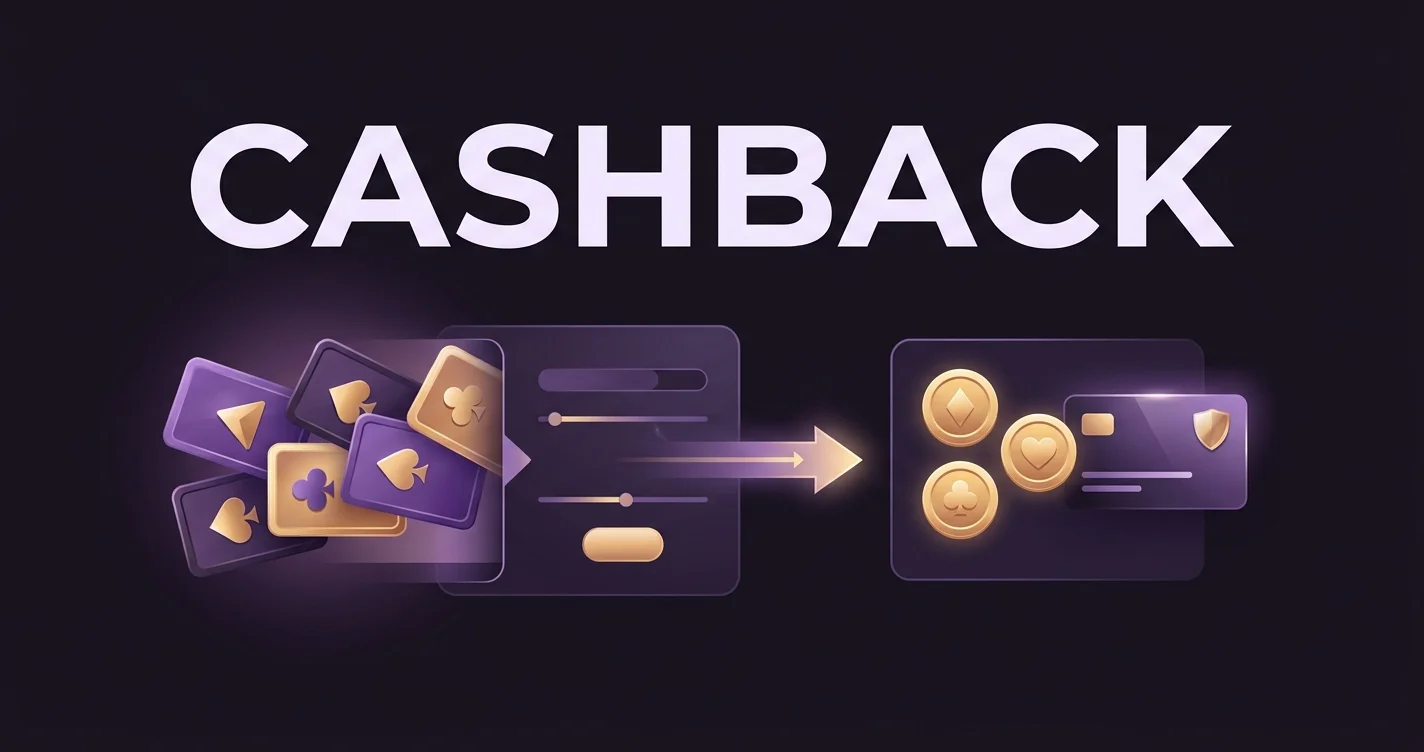
Cashback is a bonus where the casino returns part of the money a player lost over a certain period, for example 10% of weekly losses. It is not a win and it is not insurance against losing: you are still down, just by a little less.
How cashback works in simple terms
The logic is straightforward. The casino picks a period (a day, a week, a month), totals your losses for that time and returns a percentage of them. The percentage is usually fixed or depends on your level in the loyalty program.
It is important to tell three things apart:
- Calculation base. This is your loss, not the total amount wagered. If you placed bets worth 10,000 UAH over a week but ended up losing only 500 UAH, cashback is calculated on the 500 UAH.
- Percentage. This is the share of your loss that you get back.
- Terms of payout. Cashback can go to a bonus balance with a wagering requirement or to your main balance. Check this in the rules of each promotion.
If you are in profit for the period, cashback is normally not paid, since there is nothing to return. Always check the promotion description for the details of the formula (whether all games count or only some, and whether winnings are subtracted).
Calculation example
Suppose cashback is 10% of weekly losses.
- On Monday you deposit 1,000 UAH and play.
- By Sunday your balance is gone: net loss of 1,000 UAH.
- Cashback: 1,000 × 10% = 100 UAH.
Result: you lost 1,000 UAH, got 100 UAH back, and your real loss is 900 UAH. Cashback softened the loss but did not cancel it.
Now a variant with a different percentage. The same 1,000 UAH loss with 25% cashback gives 250 UAH, leaving you down 750 UAH. The difference is noticeable, but you still did not come out ahead.
What if I won first and then lost?
Suppose you won 500 UAH early in the week and then lost 800 UAH. Your net result for the week is a loss of 300 UAH. If the promotion counts net loss, cashback will be calculated on 300 UAH, not 800. That is why the cashback amount often turns out smaller than you expect.
Cashback, rakeback and a regular bonus: what's the difference
People often mix these up, although they work differently.
| Parameter | Cashback | Rakeback | Deposit bonus |
|---|---|---|---|
| What it is calculated on | Losses over a period | Every real-money bet | The deposit amount |
| When it is credited | Once per period, e.g. weekly | Continuously, from bets | After a deposit |
| Depends on the result | Yes, you need a loss | No, playing is enough | No |
A regular wagering requirement is tied to a deposit bonus: it is the number of times you must play through the bonus amount before you can withdraw. For cashback, the wagering terms can be different, as we explain below.
Cashback at Rich Top
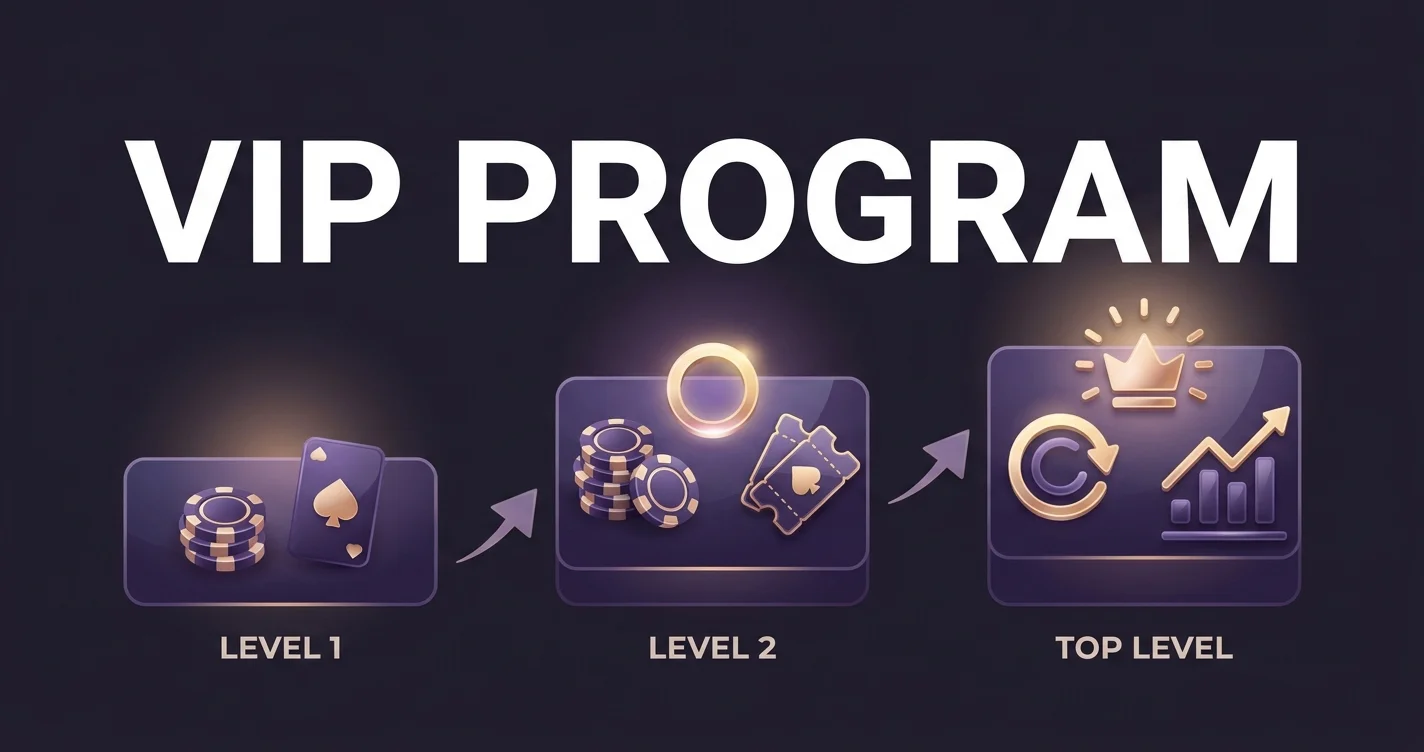
At Rich Top, cashback is credited weekly and ranges from 10 to 25% of your losses, depending on your VIP level. The higher the level, the higher the percentage returned.
The levels and percentages look like this:
| VIP level | Points required | Cashback |
|---|---|---|
| Bronze | from registration | 10% |
| Silver | from 5,000 | 15% |
| Gold | from 25,000 | 18% |
| VIP | from 100,000 | 20% |
| Brilliant | from 600,000 | 25% |
Points at Rich Top are earned from bets: 1 point for every $10 wagered (converted at the hryvnia rate). There is a multiplier for consecutive days of play: 3 days in a row - x1.5, 5 days - x2, 7 days - x3. Activity is checked over 30 days, and if you stop playing, your level may drop. Your cashback percentage will drop with it.
This is an important nuance. To move up to the next level you need to place a lot of bets, which means taking more risk. Keep that in mind when you look at a higher percentage.
Wagering on cashback
Before you claim cashback, open the bonuses section on the site and read the current terms: where the amount is credited and whether it has to be wagered. If there is a wagering requirement, you can withdraw only after meeting it. It is the same story as with other bonuses: an active bonus with an unfulfilled wagering requirement blocks withdrawals. The article on wagering requirements explains in detail how this works.
Why cashback doesn't change the math of the game
In any gambling game the casino has a mathematical advantage. It is called the house edge. It is the average percentage of all bets that the casino keeps over the long run.
Cashback reduces your losses but does not make play profitable. A simple example with simplified numbers:
- You wagered 10,000 UAH in total.
- The house edge is, say, 4%, so the expected loss is about 400 UAH.
- 10% cashback returns roughly 40 UAH.
- Expected net loss: about 360 UAH.
This is an averaged model, not a forecast: over a short stretch the result can be much better or much worse. But the conclusion is the same: cashback can be seen as a small discount on entertainment, not a way to make money.
Common mistakes and myths
Myth 1. "With cashback I can't lose"
You can. Cashback returns only a share of your losses. The rest of the money is still gone.
Myth 2. "You have to lose on purpose to get cashback"
This is a trap. If you lose 1,000 UAH for the sake of getting 100 UAH back, you have simply lost 900 UAH. This strategy brings no profit.
Myth 3. "A higher percentage means a better deal"
A percentage means nothing without the terms. 25% with a wagering requirement and strict restrictions can be less convenient than 10% with no complications. Look at three things: the calculation base, the deadlines and the wagering requirements.
Myth 4. "Cashback can be withdrawn right away"
Not always. If a wagering requirement applies to the amount, you must meet it first and only then withdraw.
Mistake: raising your bets to "catch up" with cashback
Playing to wager off cashback or chasing the next VIP level often ends with the bankroll draining faster than planned. Decide in advance how much you are prepared to spend and do not go beyond it, no matter how the cashback percentage looks. The article on bankroll explains how to do this.
How cashback affects a player's choice
It makes sense to treat cashback as an additional factor, not the main one. Here is what to do before relying on it:
- Read the terms. Find out the period, the calculation base, the percentage, the payout deadline and whether there is a wagering requirement.
- Calculate the real benefit. Multiply your typical weekly loss by the percentage. If you play infrequently and for small amounts, the return will be modest.
- Don't adjust your play to the promotion. You set the budget and the playing time, not the size of the cashback.
- Compare it with rakeback. Rakeback at RichTop is credited from every real-money bet, with no wagering requirement and straight to the main balance, and reaches up to 0.5% across VIP levels. It does not depend on whether you won or lost. Cashback works only when you lose, but the percentage is higher.
For those who play rarely and in moderation, 10% Bronze cashback is a pleasant extra. For those who play regularly, the percentage can grow, but so does the volume of bets, and with it the risk. A higher percentage on its own is not a reason to spend more.
Responsible gaming
You can play at Rich Top only from the age of 18. Gambling is entertainment, not a way to earn money, and no bonus, cashback included, guarantees a result. Play only with money you can afford to lose and do not try to win back your losses.
If you feel that your play is getting out of control, use the limiting tools. RichTop offers self-exclusion for a period from 6 months to 5 years, and the relevant section of the site collects tips on controlling your play and contacts where you can get help.
The key points
- Cashback is the return of part of your losses for a period, not a win.
- It is calculated on net loss, not on the amount wagered, so always check the exact formula in the promotion terms.
- At Rich Top, cashback is weekly, from 10% at Bronze to 25% at Brilliant.
- The house edge remains, so cashback only softens losses.
- Before claiming, find out whether there is a wagering requirement, and don't give in to the temptation to raise your bets for the sake of the percentage.




 Google

 Payment History