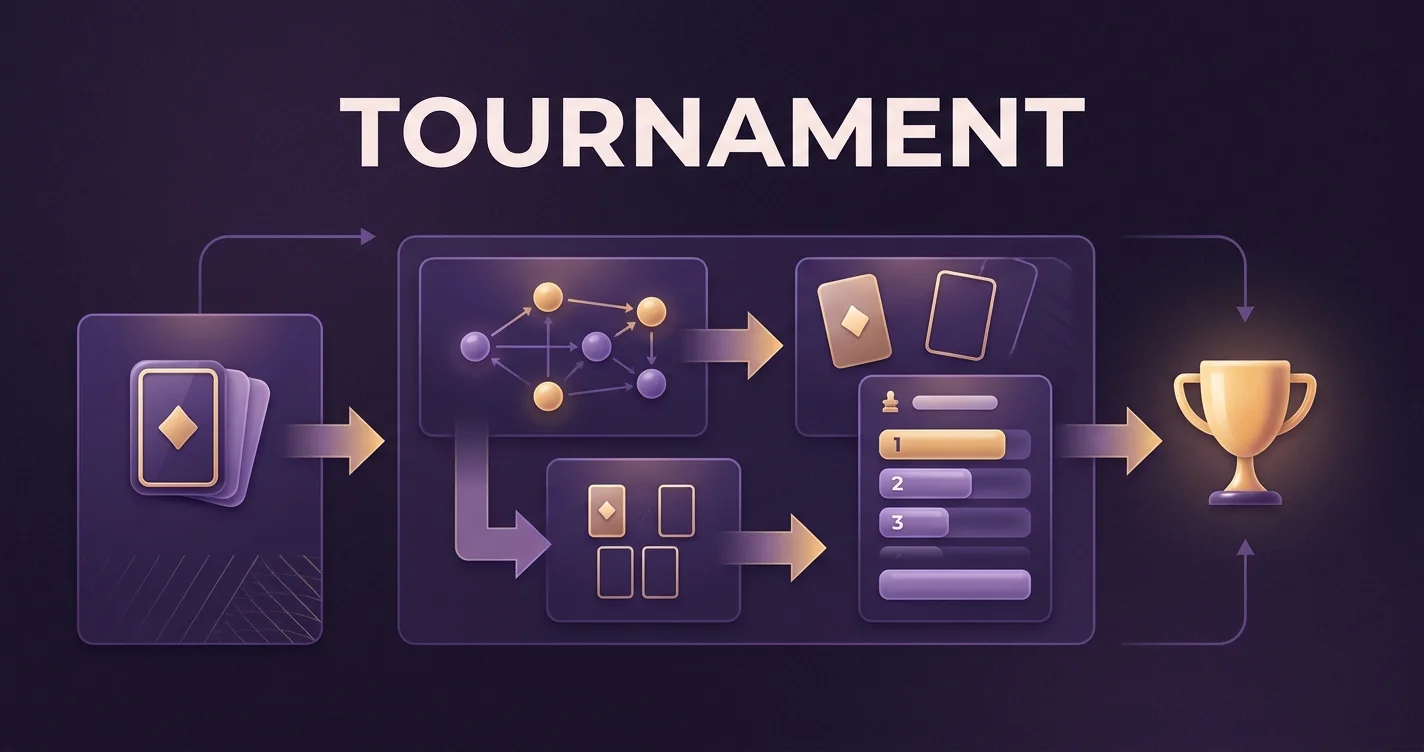
A casino tournament is a contest between players for a prize pool over a set period of time. Participants play selected games and earn points under the tournament rules, and at the end the top-ranked players share the prizes. Unlike regular play, you compete not only against the game but also against other players on the leaderboard.
A tournament does not change the math of the game itself. It adds one more goal (climbing the ranking) and one more temptation (playing more than you planned). Below we explain how it all works, run through an example, and look at how to avoid turning a tournament into an expensive trap.
How a Tournament Works
The scheme is almost always the same:
- Announcement. The casino publishes the start and end dates, the prize pool, the list of games, and the rules for awarding points.
- Participation. Sometimes it is enough to simply start playing the eligible games, and sometimes you need to click "Join". There are also tournaments with an entry fee, but in casino promotional tournaments the only cost is usually your regular play.
- Earning points. Each of your bets or wins is converted into points using the tournament formula.
- Leaderboard. The ranking updates during the tournament, so you can see your position and the gap to the players around you.
- Results. After the tournament ends, prizes are distributed by place. They are credited to your balance automatically or on request, depending on the terms.
The prize pool can be cash, free spins, bonus funds, or a mix. This matters because different types of prizes have different real value.
Main Types of Tournaments
Names differ from site to site, but the points logic comes down to a few models:
| Type | How points are awarded | Who it suits |
|---|---|---|
| By turnover | The higher the total amount wagered, the more points | Those who already play a lot. Risky for a cautious budget |
| By biggest win | The best result of a single spin or round relative to the bet counts | Those who understand it is mostly luck |
| By multiplier | The highest multiplier during the period counts | Players ready for long streaks with no result |
| Prize draw among participants | You meet a condition (for example, a minimum turnover) and enter a lottery | Those who don't want to chase a leaderboard position |
Before the start, be sure to find out which model applies to this particular tournament. Both your strategy and your spending depend on it.
What the Rules Usually Specify
The tournament rules are the most important part. Check the following points:
- Period. The date and time of the start and end, as well as the time zone.
- Games. Not every game counts. A tournament is often limited to certain slots or categories.
- Minimum bet. Spins below the threshold may not count.
- Maximum bet. Some tournaments also limit the upper bound.
- Points formula. What exactly earns points: the bet, the multiplier, or the win.
- Prize distribution. How many places are paid and how much each one receives.
- Prize type. Real money or a bonus. If it is a bonus, with what wagering requirement and validity period.
- Tiebreaks. Who ranks higher if the results are equal.
If the rules are unclear, ask support before you start playing, not afterward. Support contacts are available on the casino website.
Calculation Example
Let's take a hypothetical tournament. All the figures below are made up purely for illustration.
Terms: prize pool of 100,000 UAH, 1 point for every 10 UAH wagered, 20 places paid.
| Places | Prize | Total |
|---|---|---|
| 1 | 30,000 UAH | 30,000 UAH |
| 2 | 20,000 UAH | 20,000 UAH |
| 3 | 10,000 UAH | 10,000 UAH |
| 4-10 (7 places) | 5,000 UAH each | 35,000 UAH |
| 11-20 (10 places) | 500 UAH each | 5,000 UAH |
Total: 100,000 UAH. Now let's look at the cost of participation.
You play 10 UAH per spin and make 200 spins. Turnover: 2,000 UAH, which is 200 points. Suppose the game has a house edge of 4% (that is, an RTP of 96%). Then the expected loss from that turnover is about 80 UAH. This is an average over the long run; in reality the result can be much better or much worse.
Now imagine that 10th place requires 5,000 points. That is a turnover of 50,000 UAH. The expected loss by the same logic is about 2,000 UAH. The prize for that place is 5,000 UAH, but you may not make the top ten if someone else plays more. In that case you will spend the same expected 2,000 UAH and get nothing.
The conclusion is simple: a tournament does not cancel the math of the game. It only adds a chance at a prize, which you need to weigh against the cost of the turnover, not just the size of the prize pool.
Tournaments at RichTop
Rich Top offers tournaments with a prize pool, as well as daily quests with free spins and a jackpot with four levels. You can join from the promotions pages on the site. Check the terms of each tournament (period, games, prize distribution) in its description before the start, because they may differ from one tournament to another.
If you play from your phone, it is convenient to have the app on your home screen or the Telegram bot at hand, but the tournament rules themselves do not change because of that.
How a Tournament Affects Your Decisions
Pros
- An extra chance at a prize without a separate entry fee, if you are playing the eligible games anyway.
- A clear structure: a period, a goal, and a visible ranking.
- More excitement for those who enjoy a competitive format.
Cons and Risks
- The temptation to raise your bets. You see you are a few points short of a prize place and raise your bet beyond your plan.
- Playing for the place, not for enjoyment. This quickly turns entertainment into a race.
- End-of-tournament excitement. In the final hours the ranking changes rapidly, and the pressure on your decisions grows.
- Prizes with wagering requirements. Bonus funds must be wagered, and the real value of the prize is lower than its face value.
Common Mistakes
- Not reading the rules. You play a game that doesn't count, or bet below the minimum, and no points are awarded.
- Focusing only on the prize pool. A big pool does not mean high chances. What matters is how many places are paid and how strong the competition is.
- Ignoring your bankroll. Tournament spending should fit within the budget you set aside for play. Don't top up your account "to reach the prize places".
- Chasing losses. If you have lost, the tournament will not refund the loss. It is a standalone promotion, not insurance.
- Not checking the end time. Spins after the deadline do not count.
- Confusing a tournament with a bonus. They are different mechanics: a bonus gives you funds to play with, while a tournament lets you win a prize for your place.
Myths About Tournaments
"If you play more, you'll definitely make the prizes." No. A large turnover only raises your chance but does not guarantee a place, because other participants are playing too. Your expected losses grow as well.
"Games pay out better in tournaments." No. The result of spins depends on the random number generator and the game's parameters, not on whether the game is part of a tournament.
"There are games that surely win in a tournament." There are none. In multiplier or biggest-win tournaments the outcome is decided mostly by luck, and high volatility means results that are both rarer and larger, along with long streaks without them.
"A tournament is always profitable because it's free." Participation may be free, but your bets are not. The cost of a tournament is your real losses from play.
How to Approach a Tournament Wisely
- Rules first. Read them in full, especially the parts about games, minimum bet, and prize type.
- Set a budget in advance. How much you are ready to spend, and when you stop, regardless of your place in the ranking.
- Play what you already know. A new tournament is no reason to try an unfamiliar game with a large bet.
- Calculate the turnover. Estimate how many points you need for the prize places and what that will cost in bets.
- Set goals around enjoyment, not results. If the game has stopped being entertainment, stop.
- Take breaks. Especially in the final hours of the tournament, when the excitement is at its peak.
Responsible Gaming
You can play at Rich Top and other casinos only from the age of 18. A tournament does not guarantee a win and should not push you toward bets you did not plan. If you feel you are playing more than you intended, take a pause. Rich Top offers self-exclusion for a period from 6 months to 5 years, as well as tips on controlling your play. A simple rule also helps: the tournament ends, while your budget and peace of mind stay with you.
In Brief
- A tournament is a contest for a prize pool where your place is determined by points under the rules of a specific promotion.
- The math of the game does not change: the house edge works the same as outside a tournament.
- The value of participating depends on the points formula, the number of paid places, the prize type, and your turnover.
- The best approach: read the rules, set a budget in advance, and don't raise your bets for the sake of the ranking.





 Google

 Payment History