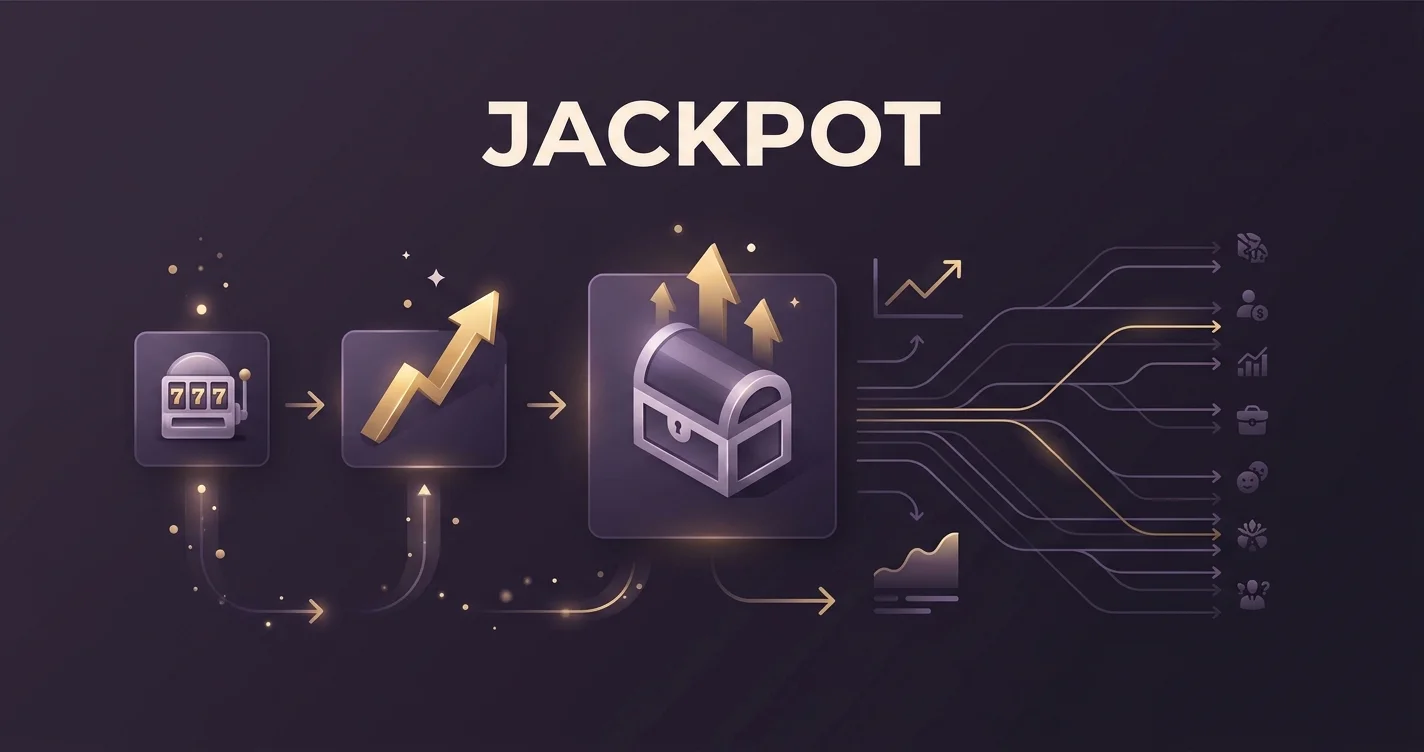
A jackpot is a special large prize in a slot that is paid out under a separate condition: a particular combination, a random trigger, or a lucky spin in a bonus game. It is usually much bigger than the regular wins in the same game. In some slots it is fixed, while in others it grows with every bet players place.
Jackpots are appealing, but the probability of winning one is very low. Below we look at the types of jackpots, where the amount comes from, how it affects a slot's return, and which mistakes to avoid.
How a jackpot works
In a classic slot, a win depends on the symbols on the reels and the paytable. A jackpot adds another mechanism: a separate sum (the pool) that one lucky player receives when the condition is met. Who wins and when is determined by a random number generator. It does not depend on how many players lost before you or how long ago the jackpot last dropped.
Activation conditions vary:
- land a certain combination of symbols on a payline;
- reach a special bonus game and win a jackpot tier there;
- get a random trigger on any spin, even without a winning combination (a so-called mystery jackpot).
The exact rules are always described in the game information. Before you play, find the jackpot section there and read it.
Types of jackpots
| Type | How the amount is formed | What to know |
|---|---|---|
| Fixed | The amount is set in advance and does not change | The prize is predictable, but usually smaller than in progressive jackpots |
| Progressive (local) | Grows from bets within a single slot or a single casino | Builds up more slowly than a network jackpot, but also drops more often |
| Progressive (network) | Grows from bets across many casinos connected to the same network | Amounts can be very large, but the chance of winning is the smallest |
| Mystery jackpot | Triggers randomly on any spin | No special combination is needed, but you must have an active bet |
| Multi-tier | Several prizes of different sizes (for example, from small to largest) | Small tiers drop more often, the top tier very rarely |
Where the amount of a progressive jackpot comes from
In progressive slots, a small percentage of every bet automatically goes into the shared pool. When someone wins, the pool resets to its starting value, called the seed. Then it starts growing again.
An example with simple numbers
Suppose the starting jackpot in a progressive slot is 10,000 UAH, and 1% of every bet goes into the pool. Players make 20,000 spins at 10 UAH each.
- Total bets: 20,000 × 10 = 200,000 UAH.
- 1% goes into the pool: 200,000 × 0.01 = 2,000 UAH.
- New jackpot size: 10,000 + 2,000 = 12,000 UAH.
In other words, each 10 UAH bet of yours contributes only 0.10 UAH to the pool. Large sums build up thanks to a huge number of spins from many people, not because of you personally.
So what is the chance of winning it?
Suppose that in some slot the probability of the jackpot on a single spin is 1 in 1,000,000. This is a hypothetical number for illustration: real values differ and are usually not disclosed in the rules. Your chance of hitting the jackpot at least once then looks like this:
- on one spin: 0.0001%;
- over 1,000 spins: about 0.1%;
- over 10,000 spins: about 1%.
Put differently, 999 out of 1,000 players who make a thousand such spins will not see the jackpot. Even after 10,000 spins, about 99 players out of 100 will still be without it. Winning is possible, but building a plan around it would be a mistake.
How a jackpot affects RTP and volatility
Part of the money a slot returns to players is set aside for the jackpot. A game's total RTP consists of two parts: regular wins and the jackpot contribution. For example, if a slot's total RTP is 96% and 1% goes to the jackpot, about 95% remains for the base game.
The practical consequence is that in slots with a jackpot, the base game often feels stingier. Wins are smaller or less frequent because part of the return is being "saved" for the big prize. That is why such games usually have high volatility: long streaks without noticeable payouts and a very rare big prize.
Smaller jackpot tiers (small and medium) sometimes help even out the gameplay: they drop more often and give more noticeable, if not gigantic, payouts.
Common mistakes and myths
"The jackpot hasn't dropped in a long time, so it's about to hit"
No. Every spin is independent. The random number generator does not remember previous results and does not keep track of who is "due" to win. This mistake is called the gambler's fallacy.
"The bigger the pool, the better the odds"
The size of the prize grows, not the probability of getting it. The chance on a single spin stays the same whether the pool is small or huge. A big pool simply attracts more players, so the jackpot drops more often overall. Your own chance on each spin does not change as a result.
"A bigger bet always increases the chance of a jackpot"
That depends on the game. In some slots a minimum bet is required to take part in the jackpot, and the bet size may determine which prize tier is available. So don't guess; read the rules of the specific slot. Raising your bet only for the sake of a "chance at the jackpot" is not worth it: you will spend your budget faster, and the casino's mathematical edge will remain. For more on this, see the article on the casino edge (house edge).
"There is a time of day or a slot when jackpots are given out"
There is no evidence for this. A random result does not depend on the time, the number of players online, or whether you played yesterday.
"If you spin enough times in a row, the jackpot will definitely hit"
More spins do increase the cumulative chance, but very slowly, as the example above shows. There is no guarantee on spin 100 or spin 10,000, and costs grow with every spin.
How this affects your decisions
- Put the jackpot last in your plan. Treat it as a rare bonus, not the goal of a session. The main entertainment is the act of playing itself.
- Set a limit in advance. For high-volatility slots it is important to have a sufficient reserve of funds. The article on bankroll covers this.
- Read the game rules. Find out whether a minimum bet is required, whether there are several tiers, and whether the win is paid out immediately or as a multiplier of your bet.
- Compare slots with and without a jackpot. If regular wins and smaller swings matter to you, slots without a progressive pool are often more comfortable.
- Pay attention to bonus terms. If you play with bonus funds or free spins, check whether jackpot slots are allowed and whether there are limits on maximum winnings or bet size during wagering. These rules are in the terms of every bonus.
The jackpot at RichTop
The promotions section features a jackpot with four tiers, alongside tournaments and daily quests. Check the promotion description on the site to see who can take part and how: that is where the current terms are stated. Rich Top also offers regular slots, and far from all of them have a jackpot, so look at the information for each game separately.
If luck is on your side, your win will need to be withdrawn under the platform's standard rules. Before you play, it is worth reviewing the withdrawal amounts and timeframes so there are no surprises. Identity verification may sometimes also be required, so it is better to know about it beforehand. If you have questions, contact Rich Top's 24/7 support by email at support@richtop.org.
Responsible gambling
A jackpot easily turns play into a chase for one big result, and that is a dangerous mindset. Don't raise your bets to "win it back," don't deposit more than planned, and take breaks. You must be 18 or older to play. If you notice that the game is no longer bringing you enjoyment, use limits or self-exclusion: on the platform it is available from 6 months to 5 years.
In brief
- A jackpot is a rare big prize that can be fixed, progressive, or mystery.
- In progressive slots, the pool grows from a small percentage of every bet.
- The chance of winning is very small and depends neither on how long ago it last dropped nor on the size of the pool.
- Part of a slot's RTP goes to the jackpot, so the base game is usually stingier and volatility is higher.
- Play with an amount you can afford to lose, and don't rely on a jackpot as a source of income.



 Google

 Payment History