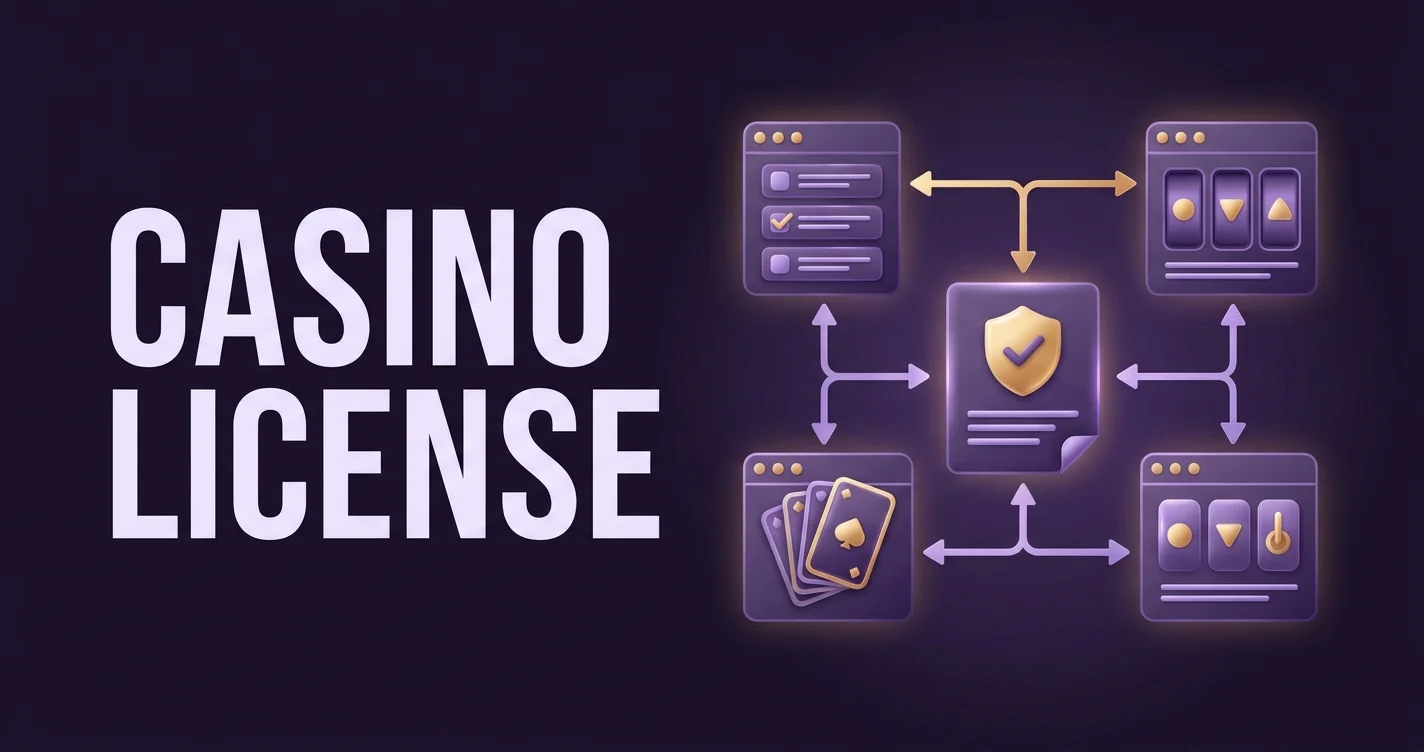
A casino license is an official permit from a national or international regulator that gives an operator the right to run gambling games. It means the company has passed a review and agreed to follow certain rules on game fairness, player protection and the handling of funds. A license does not guarantee a win and does not make gambling risk-free, but it helps you tell a regulated service from a site that answers only to itself.
What a license actually gives you
A license is issued by the regulator of a specific country or jurisdiction. The operator submits documents, goes through a review and pays fees. After that it operates under supervision: the regulator can demand reporting, test games, impose fines and, as a last resort, revoke the permit.
Depending on the jurisdiction, an operator may face requirements such as:
- Ownership transparency. The company must be a real legal entity, not an anonymous website.
- Fair games. Outcomes must be determined by a random number generator (RNG), and the game software is often tested by independent laboratories.
- Protection of player funds. In stricter jurisdictions, customer money must be held separately from the company's operating funds.
- Anti-money-laundering rules. This is where verification (KYC) comes from.
- Responsible gambling tools. Limits, breaks, self-exclusion.
- A complaints procedure. In many systems a player can turn to the regulator or to a body that handles disputes.
The exact set of requirements depends heavily on the country. That is why the phrase "the casino is licensed" says little on its own: what matters is who issued the license and what exactly they check.
Licenses come in different strengths
Regulators differ considerably in strictness. Some require tight capital controls, independent audits and quick responses to complaints. Others limit themselves to a basic company check and a fee. As a result, a license from one jurisdiction can give a player far more protection than a license from another.
In Ukraine, gambling is regulated by a state body: the Commission for the Regulation of Gambling and Lotteries (KRAIL). Operators working officially in Ukraine must obtain a permit from it. International licenses are issued by regulators in other countries and are valid within their own jurisdictions. So before you play, it is worth understanding which license is claimed, who issued it and whether that information is shown on the site.
Example: why it matters in practice
Imagine you deposited 1000 UAH and by the end of the evening your balance reached 5000 UAH. You submit a withdrawal request and get the reply: "account under review," then "rule violation," then silence. What next?
- If the operator is regulated, you have somewhere to turn: support, the complaints department, and then the regulator or a dispute-resolution body. The operator risks its license, so it has a reason to resolve conflicts.
- If there is no license or it is fake, you have nothing to pressure the operator with. It can simply ignore you, and your 5000 UAH remains a number on a screen.
This does not mean every unregulated site cheats or every regulated one pays without problems. But a license adds leverage, and that is already significant.
How to check a casino license
A license badge in a site's footer proves nothing: it can be copied in a minute. Check it like this:
- Find the details in the site footer. There you will usually see the operator company's name, the license number and the regulator.
- Go to the regulator's website. Not through a link from the casino, but by typing the address yourself. Most regulators publish a register of licensees.
- Compare the data. The company name, number, status (valid, suspended, revoked) and site address must match.
- Read the terms of use. They should state which company is the party to the agreement with the player.
- Make sure it is the genuine site address. A fake mirror can neatly copy someone else's design and even someone else's license details.
| What to check | Warning sign |
|---|---|
| Operator name | Not stated or doesn't match the register |
| License number | Missing, not found in the register |
| License status | Suspended, expired or revoked |
| Terms of use | No clear withdrawal rules, vague description of the contracting party |
| Support | Only a form with no contact details, no replies |
Common mistakes and myths
"It has a license, so I'll definitely win"
No. A license concerns the operator's fairness, not your result. In any game the house edge applies, and over the long run it works against the player. A license only ensures that the rules are the same for everyone.
"The regulator's logo at the bottom of the page is proof"
No. A logo can be pasted anywhere. Proof is an entry in the regulator's register that you found yourself.
"All licenses are the same"
No. Everything differs: capital requirements, audits, advertising controls, the speed of complaint handling. Find out what exactly this particular regulator checks.
"No license always means a scam"
That is too categorical a claim, but the risk is genuinely higher. Without a regulator you rely only on the operator's reputation and goodwill. For gambling with real money, that is weak support.
"A license protects against withdrawal problems"
Not entirely. Even with a regulated operator, a request may be delayed if you haven't completed verification, haven't wagered a bonus or entered incorrect details. This is common practice, not a violation. Before you play, read the withdrawal terms and wagering requirements.
License and verification: the link
When a casino asks for documents, it is often precisely because of regulator requirements: to check age, identity and the source of funds. So a request to complete KYC before withdrawal is not a sign of fraud but normal practice. What is suspicious is rather the opposite: when large sums are promised to be paid out without any checks.
For example, RichTop has a separate verification guide: when it is requested, which documents are accepted and how to upload photos and a selfie. Prepare clear photos of your documents in advance, and you won't have to worry at the moment of withdrawal.
What else to check besides the license
A license is only one layer of security. Also pay attention to:
- Support. Whether there is live chat, email and Telegram, and whether they respond quickly and to the point. For example, at Rich Top support works around the clock: on-site chat, Telegram and email at support@richtop.org.
- Withdrawal rules. Minimum and maximum amounts, timeframes, wagering requirements; see also site mirrors and safe access.
- Self-limitation tools. Whether you can set a limit, take a break or self-exclude.
- Reputation. Read complaints and reviews critically: look for patterns, not isolated emotional stories.
- The genuine address. Keep the official site in your bookmarks and don't follow unfamiliar links from chats.
How this affects your choice
A practical approach looks like this:
- First check who issued the license and where, and find the operator in the register.
- Read the terms of use, especially the sections on withdrawals, bonuses and account closure.
- Start with an amount you can afford to lose and make a trial withdrawal when you're ready.
- Don't keep more in your account than you need to play. A license does not insure your bankroll against losses.
- Always take the risks into account: a license reduces them but does not eliminate them.
This logic works for any operator. If the company details are incomplete, the terms are vague and withdrawals are promised "with no checks whatsoever," it is better to choose another site.
Responsible gambling matters more than any license
The best license won't protect you from the main risk: losing more than you planned. You may play only from the age of 18. Decide on an amount and a time limit in advance, don't chase losses and don't treat gambling as a way to make money.
If you feel you are losing control, use the limitation tools. At Rich Top you can arrange self-exclusion for a period from 6 months to 5 years, and a separate guide collects tips on controlling your play and contacts where you can get help. Don't wait until the problem becomes serious.
In short
- A license is a regulator's permit that imposes rules on the operator and gives the player a chance at protection.
- Who exactly issued it matters: requirements differ between jurisdictions.
- Check the number and status in the regulator's register, not by the logo on the site.
- A license does not guarantee a win and does not cancel the house edge.
- Verification and document checks are usually the norm, not a cause for suspicion.
- Look at support, withdrawal terms and self-limitation tools.
- Play only from the age of 18, within your budget and purely for entertainment.




 Google

 Payment History