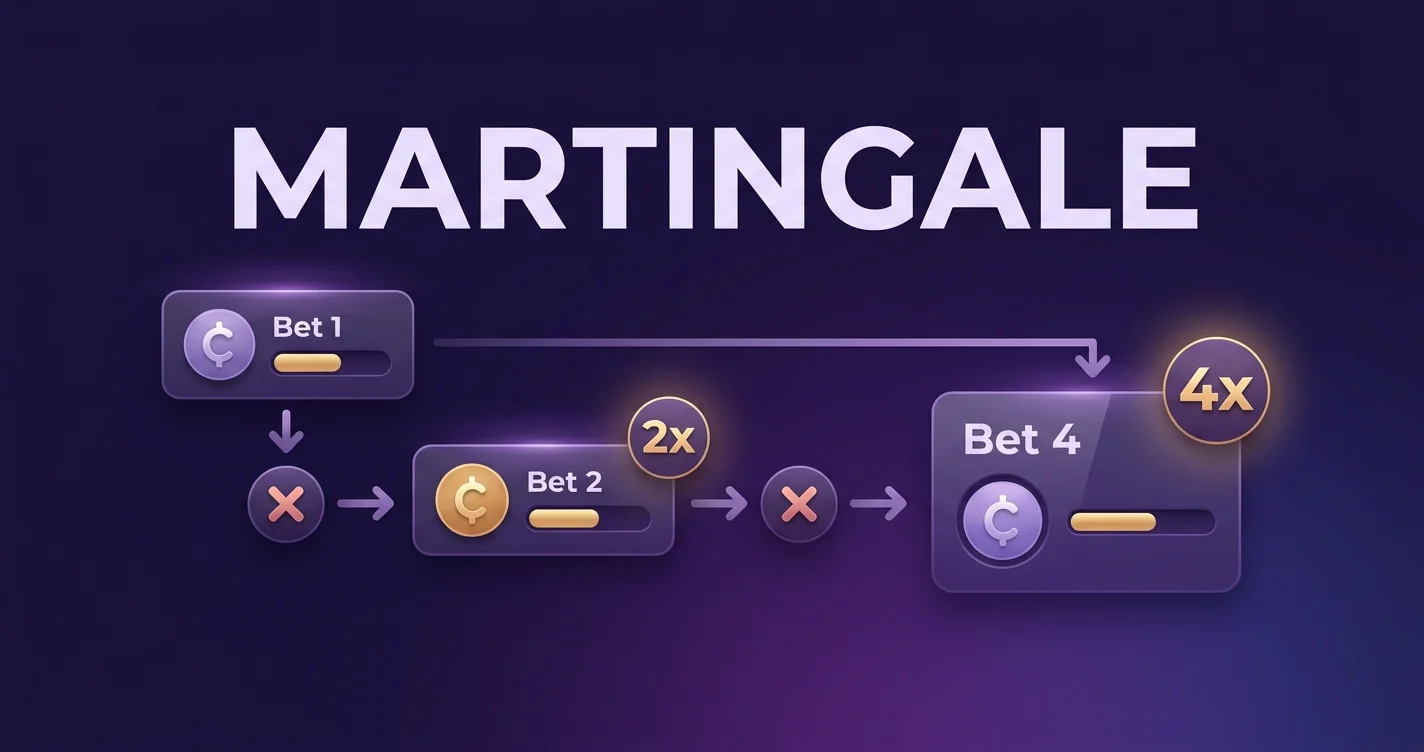
The Martingale is a betting strategy in which the player doubles the stake after every loss and returns to the original amount after a win. The idea is that a single win will cover all previous losses and add a profit equal to the first bet. In practice, the strategy does not change the casino's mathematical edge; it only changes the shape of the risk: many small wins and a rare but very large loss.
How the Martingale works
The strategy is usually applied to even-money bets (1 to 1 payout), where the chance of winning is close to 50%. For example, red or black in roulette, odd or even, high or low. The algorithm is simple:
- Choose a base bet, for example 10 UAH.
- If you lose, double the next bet.
- Keep doubling after every loss.
- After the first win, go back to the base bet and start a new series.
Why it "works" on paper: after a win you always get a net profit equal to the base bet. The final bet covers all previous losses combined, plus those same 10 UAH on top.
An example with simple numbers
Suppose the base bet is 10 UAH and we bet on red in European roulette with a single zero. A losing series looks like this:
| Attempt | Bet, UAH | Total spent, UAH |
|---|---|---|
| 1 | 10 | 10 |
| 2 | 20 | 30 |
| 3 | 40 | 70 |
| 4 | 80 | 150 |
| 5 | 160 | 310 |
| 6 | 320 | 630 |
| 7 | 640 | 1,270 |
| 8 | 1,280 | 2,550 |
If the win comes on the fourth attempt, for example, you receive 160 UAH (an 80 UAH stake plus an 80 UAH payout). You had spent 150 UAH. Net result: plus 10 UAH. The same happens on the fifth or the eighth attempt: the profit always equals the first bet.
Now the key point: the stake grows exponentially. To win 10 UAH after eight losses in a row, you have to bet 2,560 UAH, and your total risk is already over 5,000 UAH (2,550 UAH already lost plus the 2,560 UAH new bet).
A simple formula
If the base bet is B and n is the number of consecutive losses, then:
- after n losses you have lost B × (2ⁿ − 1) in total;
- the next bet will be B × 2ⁿ;
- a win at the end of the series always gives a net profit of B.
Here 2ⁿ means the number 2 multiplied by itself n times. For n = 6 we get 2⁶ = 64, so six losses in a row cost B × (64 − 1) = 63B. With a base bet of 10 UAH that is 630 UAH, as in the table above. The risk in such a series is 63 times the base bet, while the potential profit is only one base bet.
What a losing series really costs
European roulette has 37 pockets: 18 red, 18 black and one green zero. The probability of winning on red is 18/37, or about 48.6%. The probability of losing is 19/37, or about 51.4%.
The probability of several losses in a row:
- 6 in a row: about 1.83% (roughly once in 55 series);
- 8 in a row: about 0.48% (roughly once in 200 series);
- 10 in a row: about 0.13%.
That looks like a very rare event, but it does happen. The game doesn't "remember" previous results, and over a long evening you can play dozens of series.
Let's calculate with a real bankroll
Say you have 1,000 UAH and a base bet of 10 UAH. You can make six bets: 10, 20, 40, 80, 160, 320. That totals 630 UAH. You can no longer afford the seventh bet (640 UAH): you would have only 370 UAH left. So six losses in a row means the end of the strategy, and your loss is 630 UAH, or 63% of your entire bankroll.
Let's look at the expected result of one series:
- with a probability of about 98.17% you win 10 UAH (about +9.82 UAH on average);
- with a probability of about 1.83% you lose 630 UAH (about −11.55 UAH on average).
In total that comes to roughly minus 1.7 UAH per series. In other words, over the long run you don't beat the system; you simply hide your losses behind a long string of small wins. This is a direct consequence of the house edge: the 2.7% on even-money bets in European roulette doesn't go anywhere, no matter how much you double.
Limits that break the strategy
In theory, the Martingale would work only under two conditions: an infinite bankroll and no bet limit. In reality, neither exists.
- A finite bankroll. Each doubling quickly eats up the available funds. For more on managing it, see our article on the bankroll.
- The table maximum. Even if you have the money, the rules won't let you bet more than the limit. The series is cut off exactly when you need it most.
- The zero. The green zero loses both red and black bets. It is what pushes the probability of winning below 50%.
- The minimum bet. It doesn't let you reduce the starting amount to pennies to "stretch" the series.
Common mistakes and myths
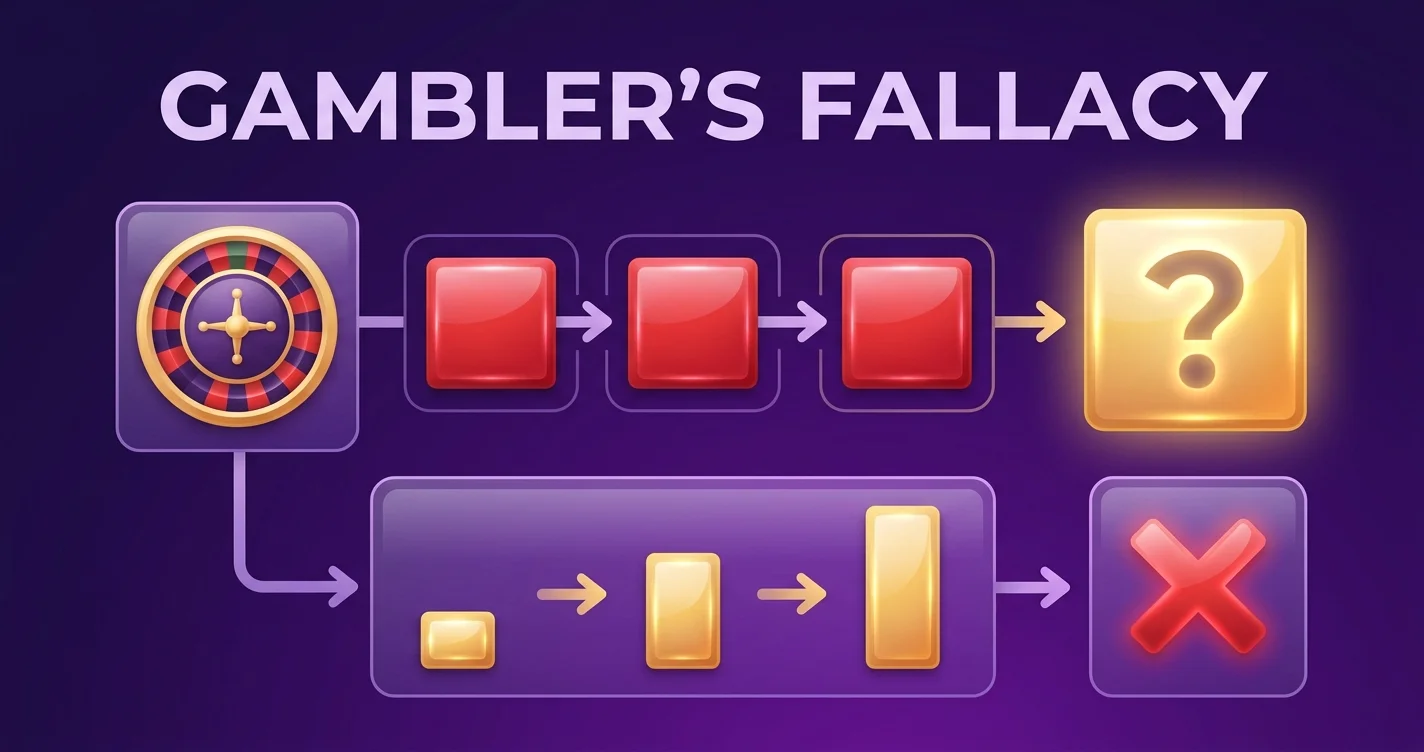
Myth 1: "After a long run of red, black is bound to come up"
This is the so-called gambler's fallacy. Every spin of the roulette wheel is independent. After ten reds in a row, the probability of black next time is the same as at the start. The wheel or the random number generator doesn't "compensate" for previous results.
Myth 2: "The Martingale guarantees a profit"
It only guarantees that most series end with a small win. But one unlucky series can wipe out the result of many dozens of successful ones. No betting system can turn a game with a negative expectation into one with a positive expectation.
Myth 3: "The Martingale can be applied to slots"
In slots there is no bet with a 1 to 1 payout and a probability of about 50%. Wins there are rarer, uneven and depend on volatility. Doubling your bet after a loss doesn't even guarantee that you'll get back what you lost. Such a "system" just speeds up spending.
Other typical mistakes
- Starting with a base bet that is too large, so the bankroll withstands only 3-4 doublings.
- Continuing to double for "one more try" when the next bet already exceeds a comfortable amount.
- Topping up your account in the middle of a series to "win back" a loss. That is already chasing losses.
- Applying the Martingale to bonus funds without checking the rules. Bonuses often have maximum bet limits, and breaking them can void your winnings.
Similar strategies
The Martingale has several relatives, and they all work on the same logic of changing the bet based on the result:
- Anti-Martingale (Paroli). The stake is increased after a win and returned to the base amount after a loss. The risk is lower: a loss is limited to a single bet, but large wins require a series of victories.
- D'Alembert. The stake is increased by one unit after a loss and decreased by one after a win. Growth is slower, but this too does not change the mathematical edge.
- Fibonacci. Bets follow the numbers in the sequence 1, 1, 2, 3, 5, 8 and so on. Growth is slower than doubling, but a losing series quickly becomes expensive as well.
All of these schemes only manage how results are distributed over time. The expected result in a long game remains negative, because it is determined not by the order of bets but by the house edge.
Where the Martingale is used at all
It is most often tried in roulette, blackjack and baccarat, where there are bets close to even odds. But there is a nuance: in blackjack the probability of winning depends on your decisions, and payouts are not always 1 to 1 (for example, 3 to 2 for a blackjack). In baccarat, a bet on the banker usually pays out with a commission. These details shift the calculations slightly but do not change the main conclusion.
How the Martingale affects your decisions
If you still want to try the strategy for fun, first decide how many doublings you are ready to survive, and only then calculate the base bet from that. That is the right order of calculation, not the other way around.
How to choose a base bet
A series of n bets costs B × (2ⁿ − 1). So the base bet must be very small relative to your session budget. Benchmarks for a session bankroll of 1,000 UAH:
| Series limit | Cost of the series in base bets | Base bet so the series costs up to 10% of the bankroll | Base bet so the series costs up to 63% of the bankroll |
|---|---|---|---|
| 4 bets | 15 | about 6.5 UAH | about 42 UAH |
| 5 bets | 31 | about 3 UAH | about 20 UAH |
| 6 bets | 63 | about 1.5 UAH | 10 UAH |
The last column is the example from this article: 10 UAH on a 1,000 UAH bankroll. Here six losses in a row take more than half the bankroll for the sake of a 10 UAH profit per series. If you want a failed series not to hurt, the base bet should be several times smaller, and the profit per series shrinks along with it. That is the honest price of the strategy, not a flaw in these particular numbers. If the table minimum doesn't let you lower the base bet that far, the Martingale simply isn't for you.
A few more practical rules:
- Set a series limit in advance. For example, no more than 5 bets. If you reach it, stop and accept the loss.
- Count the cost of the series, not just the first bet. It shows how much you are risking at the start.
- Never top up your account to continue a series. You decide the money for play before the session starts, not during it.
- Don't treat small wins as proof the system works. They are just part of the distribution.
- Set a win limit. If you've reached the amount you wanted, end the session.
The most honest view of the Martingale is this: it is a way to buy a high frequency of small wins at the price of a rare large loss. Whether you need that trade-off is up to you, but it's worth understanding the price in advance.
Responsible gambling
The Martingale is especially dangerous because it creates an illusion of control. After a series of wins it seems that everything is under control, and one bad episode quickly eats the entire balance. You may play only from the age of 18, and the money you play with must be money you are ready to lose without harming your budget.
If you notice that you are raising your bets to win back losses, doing so more often than you planned, or playing with money you need for essential expenses, take a break. At RichTop you can set limits for yourself: there is self-exclusion from 6 months to 5 years, as well as tips for staying in control of your play.
In brief
- The Martingale means doubling the bet after a loss and returning to the base bet after a win.
- Each winning series brings in only the amount of the first bet.
- A series of n losses costs B × (2ⁿ − 1), so risk grows much faster than profit.
- Bet limits and the bankroll constrain the strategy, and the base bet should be calculated from the series limit.
- The probabilities of each spin are independent, so there is no "pattern".
- The strategy doesn't get around the house edge and doesn't guarantee a win.






 Google

 Payment History