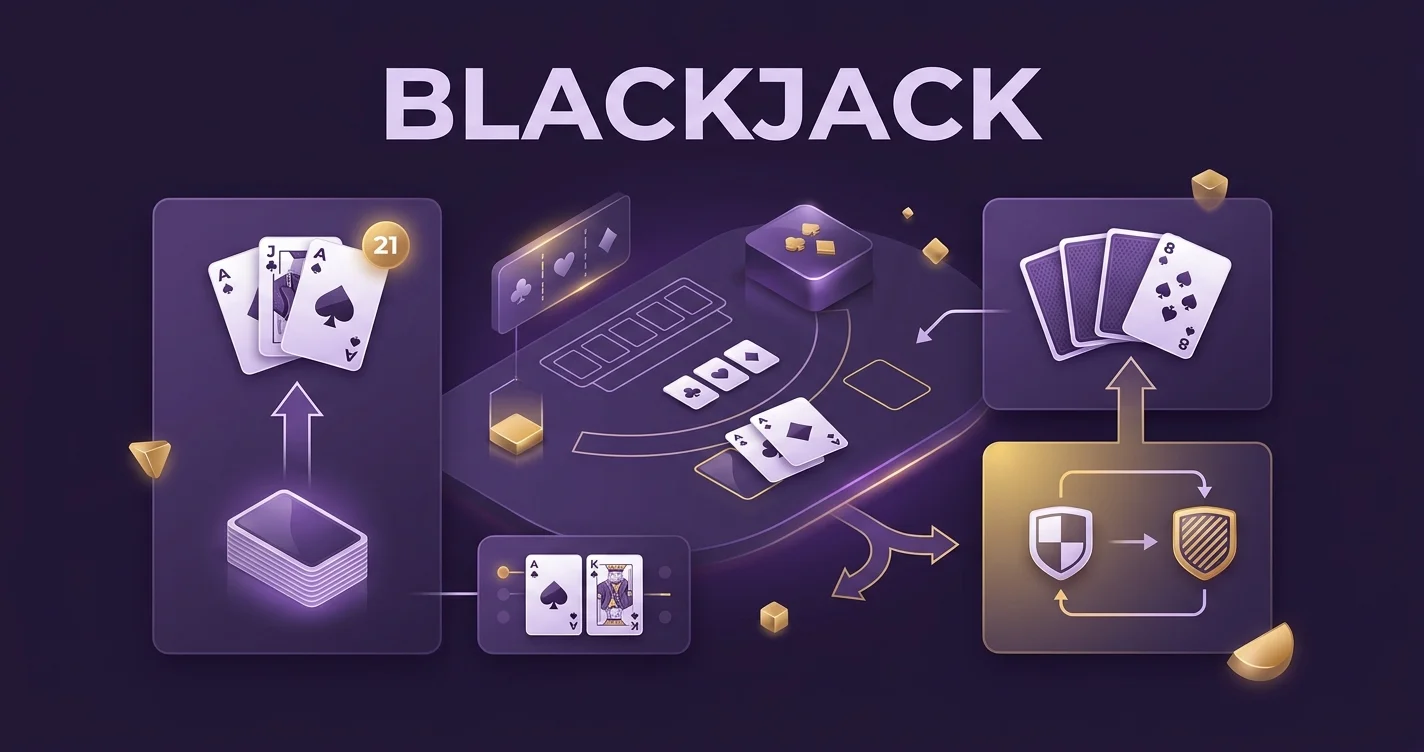
Blackjack is a card game against the dealer where you need to score higher than the dealer without going over 21. You don't play against the other players at the table: everyone competes only with the dealer. It is one of the few casino games where a player's correct decisions noticeably affect the result in the long run.
How blackjack works
The goal is simple: the total of your cards must be closer to 21 than the dealer's. If you go over 21 (bust), you lose immediately, even if the dealer busts afterwards too.
Card values
- Cards from 2 to 10 count at face value.
- Jack, queen, king are worth 10 points each.
- Ace is worth 1 or 11, whichever suits the hand better.
A hand with an ace that can count as 11 without busting is called "soft". For example, an ace and a 6 make a soft 17. If the ace has to count as 1, the hand becomes "hard".
How a hand plays out
- You place a bet before the hand starts.
- You are dealt two cards, and the dealer gets one face-up card and one face-down card (in some rule variants the timing of the dealer's second card differs).
- You make decisions about your hand in turn.
- When you are finished, the dealer reveals their card and draws according to fixed rules. Usually the dealer draws up to 16 and stands on 17 or more. Whether the dealer draws on a soft 17 depends on the rules of the particular table.
- The hands are compared, and your bet wins, loses or is returned.
Player actions
| Action | What it means |
|---|---|
| Hit | Take one more card. |
| Stand | Stay on your current total. |
| Double | Double your bet, receive exactly one card and end your turn. |
| Split | If your first two cards are the same, split them into two hands by placing a second bet. |
| Insurance | A side bet offered when the dealer's up-card is an ace. |
| Surrender | Not available at every table: you give up half your bet and end the hand. |
The available actions and restrictions (for example, whether you can double after a split) depend on the table rules, so it's worth reading them before you start playing.
Payouts: why 3:2 versus 6:5 matters
If your first two cards add up to 21 (an ace and a ten-value card), that's a natural blackjack. The classic payout for it is 3 to 2. A regular win pays 1 to 1.
Some tables pay only 6 to 5 for blackjack. The difference seems small, but it is decisive.
Example with a 100 UAH bet:
- With a 3:2 payout, a natural blackjack brings 150 UAH in profit (250 UAH returned in total).
- With a 6:5 payout, the profit is only 120 UAH (220 UAH returned in total).
That's a 30 UAH difference on every blackjack. A natural blackjack comes up roughly once in every twenty to twenty-one hands. So over 1,000 hands at 100 UAH, that's about 48 blackjacks and over 1,400 UAH of "missing" money. This is exactly why a 6:5 table favors the casino, not you.
The house edge in blackjack
Like any casino game, blackjack has a built-in mathematical advantage for the house. We covered this concept in more detail in our article on the house edge. In blackjack it depends on the table rules and on how well you play.
With favorable rules (3:2 payout, few restrictions on actions) and basic strategy, the house edge is usually a fraction of a percent, roughly one and a half percent or less. That is noticeably lower than in many slots. But it does not guarantee a win: short sessions still depend on luck, and you can lose even with perfect play.
The house edge is affected by the following rules:
- the blackjack payout (3:2 is better than 6:5);
- whether the dealer draws on a soft 17;
- the number of decks;
- the ability to double after a split;
- the availability of the surrender option.
Basic strategy
Basic strategy is a set of mathematically optimal decisions for every combination of your hand and the dealer's up-card. It wasn't invented by gut feeling: it comes from calculating all possible scenarios. You don't need to work it out yourself, just remember the main principles.
General guidelines
- Hard 17 and above: stand.
- Hard 12-16: stand if the dealer has a weak card (2 to 6), because the dealer is likely to bust. Hit if the dealer has a strong card (7 and above).
- 11: usually double, because the chance of getting a ten-value card is high.
- 10: double against weak and medium dealer cards.
- Pair of aces and pair of eights: always split.
- Pair of tens and pair of fives: don't split tens (20 is a very strong hand), and it's better to treat fives as 10 and double.
Example decision
You have 16 and the dealer shows a ten. Hitting feels scary, and standing isn't comforting either. According to strategy, the correct play is to hit, even though the risk of busting is high: standing on 16 against a ten loses more in the long run. This is a classic case where "feeling" says one thing and math says another.
If you have 11 and the dealer has a 6, the correct action is to double. You bet more exactly when your position is strongest.
Basic strategy charts for different rules are easy to find in the public domain. Many online versions of the game have a built-in hint you can use to check yourself during practice.
Common mistakes and myths
"Insurance is a good deal"
Insurance is offered when the dealer shows an ace. It looks like protection for your hand, but it is actually a separate bet that the dealer's hidden card is worth 10. In the long run it is unfavorable for the player, and basic strategy usually advises declining it.
"The dealer already has a weak card, so I should take the risk"
The decision depends on the math of the hand, not on the mood at the table. If strategy says stand, it isn't cowardice.
"The previous player ruined my game"
How others at the table play does not change the probabilities for your hand in the long run. One ill-judged move by a neighbor can change the order of the cards, but it can just as easily improve it. Blaming other players makes no sense.
"A betting progression guarantees a profit"
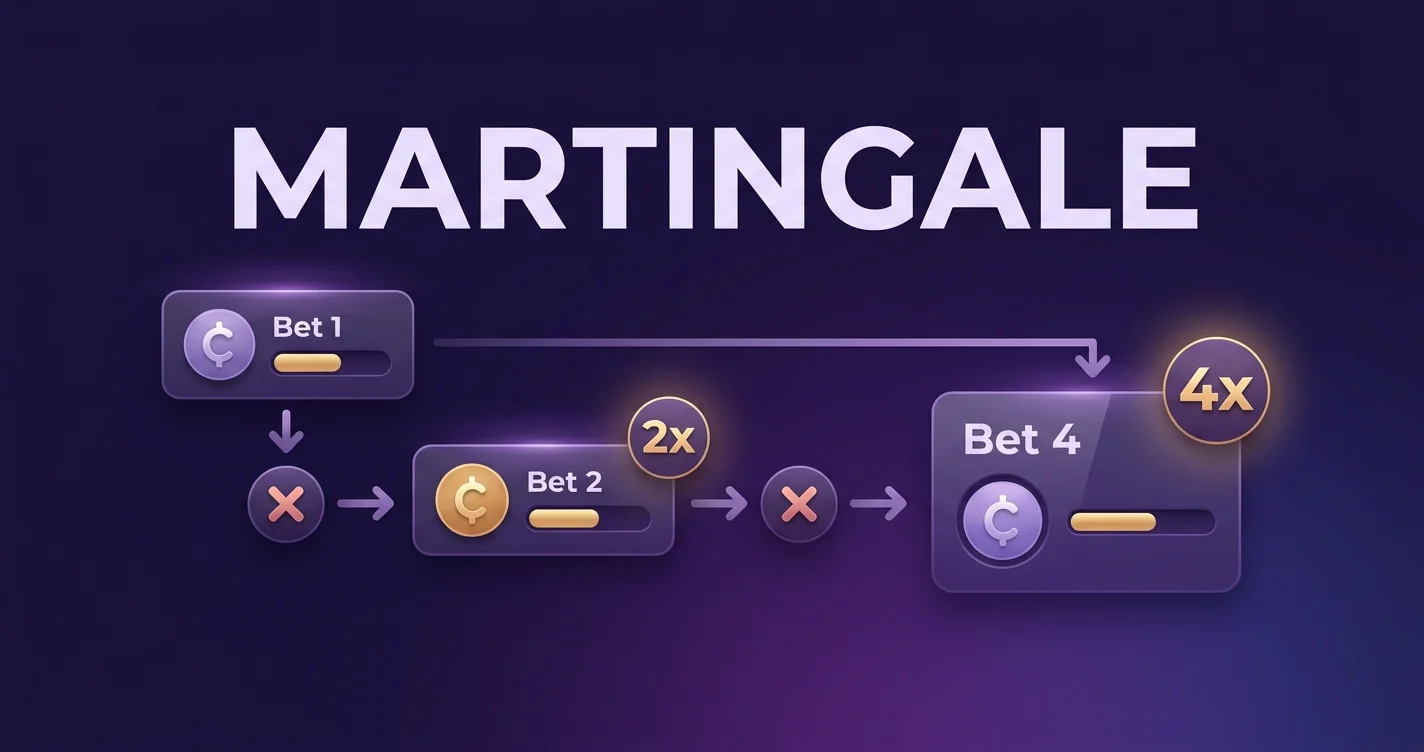
Systems like doubling your bet after a loss don't change the casino's mathematical advantage. They only increase the amounts and the risk faster, and tables have bet limits. Such play usually ends in a big loss after a few bad streaks.
"Card counting works online"
Card counting is a method of tracking the ratio of high to low cards in the deck. In online versions with a random number generator, where the deck is reshuffled after every hand, it is pointless. In live formats, several decks and frequent reshuffles are usually used, so in practice counting is almost impossible, and venues may ban such play in their rules.
Ignoring side bets
Many tables offer extra bets: on a pair in the first cards, on combinations with the dealer's cards and so on. They look attractive because of their big payouts, but the house edge on them is usually much higher than in the main game. If your goal is to preserve your odds, it's better not to complicate the main game.
Online blackjack and live blackjack
There are two main formats:
- RNG blackjack. The cards are dealt by software that simulates shuffling. The game is fast, stakes are usually lower, and you can play at your own pace.
- Live blackjack. A real dealer deals real cards, and you watch the table via a video stream. You can read more about this format in our article on live casino. The pace is slower, there is chat interaction, and rounds have time limits for decisions.
For learning basic strategy, RNG versions are more convenient: nobody rushes you, and mistakes don't cost you time at the table. The live format suits those who value atmosphere. There are live games at RichTop too, so you can compare both formats and choose your own.
Blackjack and bonuses
If you play with a bonus, be sure to read its terms. Bonuses are usually tied to wagering, meaning the amount of bets you must place before withdrawing. Games may contribute to this requirement differently: table games are often counted only partially or not at all. So before you clear a bonus on blackjack, check the wagering section and the list of allowed games at Rich Top. This will save you time and spare you from wondering later why you can't withdraw.
How blackjack shapes your decisions
- Choose a table by its rules. A 3:2 payout, clear rules on the dealer's soft 17 and the ability to double after a split matter more than a nice interface.
- Learn the strategy before playing for money. This is the best investment of your time: every mistake at the table has a price.
- Set an amount for the session. Sensible money management is described in our article on the bankroll: a separate sum you are prepared to spend, and a bet size that is a small fraction of it. Then a run of unlucky hands won't knock you out of the game in a few minutes.
- Don't chase losses. Hasty, bigger bets after a setback most often only deepen the loss.
- Don't mistake a lower house edge for a guarantee. Even the best strategy doesn't promise a win, it only reduces the mathematical loss.
Responsible gaming
Blackjack can create a feeling of control, because your decisions really do matter. However, the outcome of each hand remains random. Play only with amounts that don't hurt your budget, take breaks, and don't treat the game as a way to earn money. Gambling is allowed only from the age of 18. If you notice you are losing control, use the limiting tools: at Rich Top you can set up self-exclusion for a period from 6 months to 5 years.
In brief
- Blackjack is a game against the dealer where the goal is to score more than the dealer without going over 21.
- Table rules (especially a 3:2 or 6:5 payout) significantly change your mathematical position.
- Basic strategy helps minimize the house edge but does not guarantee a win.
- Insurance, betting progressions and side bets usually don't improve your chances.
- Play with a clear limit, don't chase losses, and remember 18+.




 Google

 Payment History