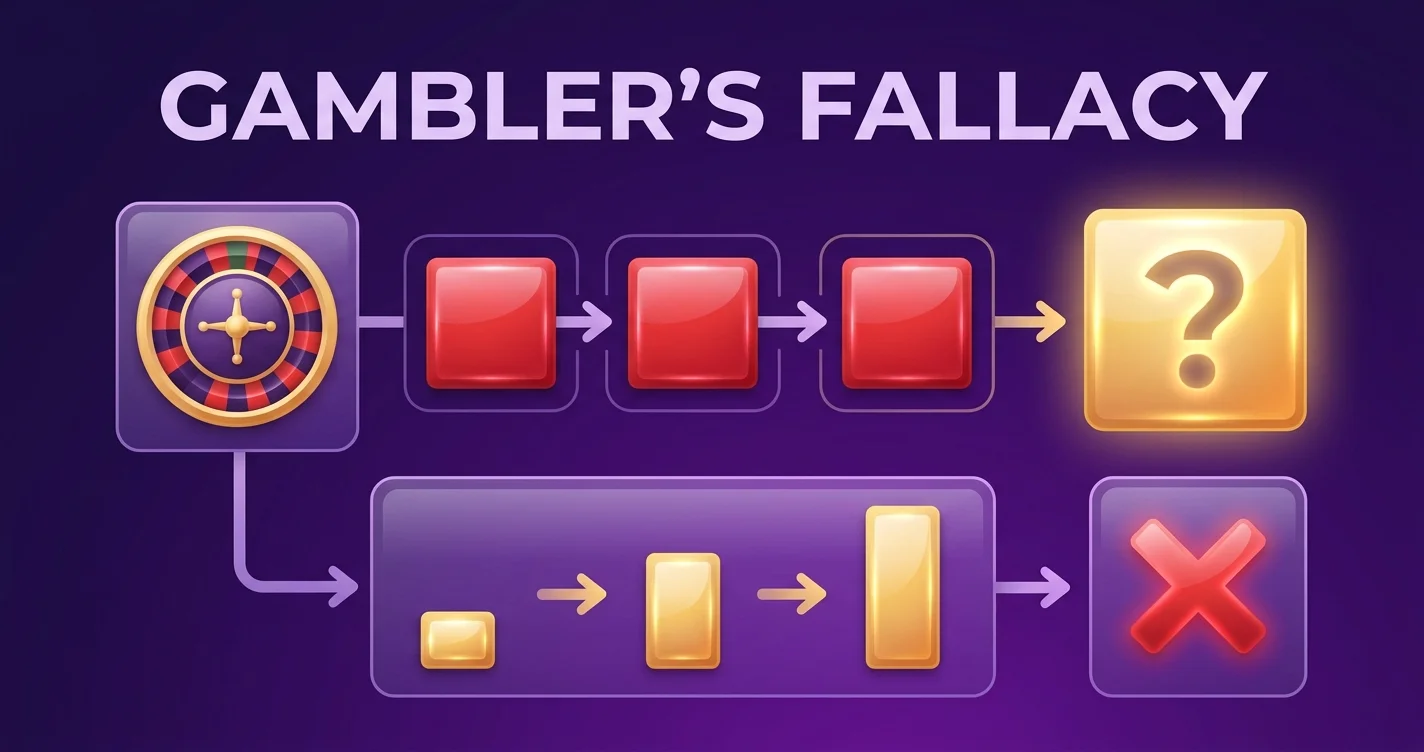
The gambler's fallacy is the mistaken belief that after a streak of identical results, the next result "must" be the opposite. For example, if red has come up five times in a row, black is supposedly "about to hit." In reality, in games with independent events, the past has no influence on the future.
How the gambler's fallacy works
Imagine a simple coin. The probability of heads is 50%. The coin has no memory: it doesn't know how many times tails came up before. So after ten tails in a row, the chance of heads on the next flip is still 50%.
The brain doesn't think that way. We intuitively expect a short run of random events to look "balanced." A streak of ten tails feels "wrong" to us, and we subconsciously assume the world will correct it. It won't.
The key word here is independence. Every spin, toss or turn of the wheel is a separate event. The result of the previous round isn't passed on to the next one.
A roulette example
Take European roulette: 37 pockets, of which 18 are red, 18 are black and one is a green zero. The probability of red on a single spin is:
18 / 37 ≈ 48.6%
Now let's compare two things that are often confused:
- the chance that 5 reds in a row will come up before the streak begins: 0.486 to the fifth power, or roughly 2.7%;
- the chance that a sixth red comes up after five reds: still the same 48.6%.
The chance of six reds in a row from the very start is about 1.3%. That's half the figure for five. This is exactly where the misconception is born: "six in a row is very rare, so black must come now." But the five reds have already landed; they're in the past. For the sixth spin only that spin counts, and its chance of red is the same 48.6%.
| Situation | Probability of red |
|---|---|
| First spin | ≈ 48.6% |
| After 3 reds in a row | ≈ 48.6% |
| After 5 reds in a row | ≈ 48.6% |
| After 10 reds in a row | ≈ 48.6% |
The figure doesn't change, however long the streak. Neither the wheel nor a random number generator has any "compensation" mechanism.
The law of large numbers doesn't save you
Defenders of the "law of averages" often cite probability theory: over a long game, they say, everything evens out. That's only partly true, and not at all in the way they think.
The law of large numbers says that the share of heads approaches 50% over time. It doesn't say the coin "pays back its debt." Consider the numbers:
- after 10 flips, 10 heads came up, or 100%;
- we then make another 1,000 flips and expect roughly 500 heads;
- total: roughly 510 heads out of 1,010, or about 50.5%.
That initial surplus didn't go anywhere. It was simply "dissolved" by the huge number of new flips. The gap between the number of heads and tails can even grow, even though the share approaches 50%. Evening out happens through dilution, not through correction.
Why we believe it
- The intuition of "representativeness." We expect even short streaks to look "random." The sequence "heads, heads, heads, heads, heads" looks suspicious to us, while "heads, heads, tails, heads, tails" seems natural. Yet every specific sequence of five flips has the same probability: 1 in 32. There are simply far more "mixed" sequences than "uniform" ones, so as a group they occur more often.
- The desire to find a pattern. The brain looks for patterns even where there are none.
- Excitement and losses. After losing, you want to believe that "the next bet will surely win it back."
- Statistics on screen. The history of recent numbers in roulette or streaks of results in live games creates the illusion that something can be read from them.
Where the gambler's fallacy appears most often
Roulette and red/black games
The classic of the genre. The player sees a long streak of one color and raises the stake on the opposite one. But the odds of the color haven't changed, and the casino's edge remains in place: because of the zero, every color bet is slightly losing over the long run.
Slots
"This machine hasn't paid out for a long time, it's due." It's the same fallacy. In a modern online slot, the result of each spin is determined by a random number generator, and it doesn't keep a ledger of any "debt" to the player. A long streak without a win doesn't increase the chance of winning on the next spin.
Moreover, long "dry" stretches are a normal feature of high-volatility games. They are not a signal that something is "about to happen."
Crash games and other fast formats
"There were five small multipliers in a row, so a big one will fly out now." The rounds are independent. Past multipliers don't predict the next one.
Baccarat and live tables
In live games, the screen often shows the history of results as "roads" or lists. They look like analytics, but they're of little use for guessing the next round. You can read them as interesting statistics, not as a forecast.
The flip side: the "hot hand"
There is a mirror-image fallacy: the belief that a streak will continue. "I'm lucky right now, so I should play more." This is just as baseless if the events are independent. A winning streak doesn't make the next spin more favorable. Both fallacies share the same root: we attribute to past results a power they don't have.
The gambler's fallacy and the doubling strategy
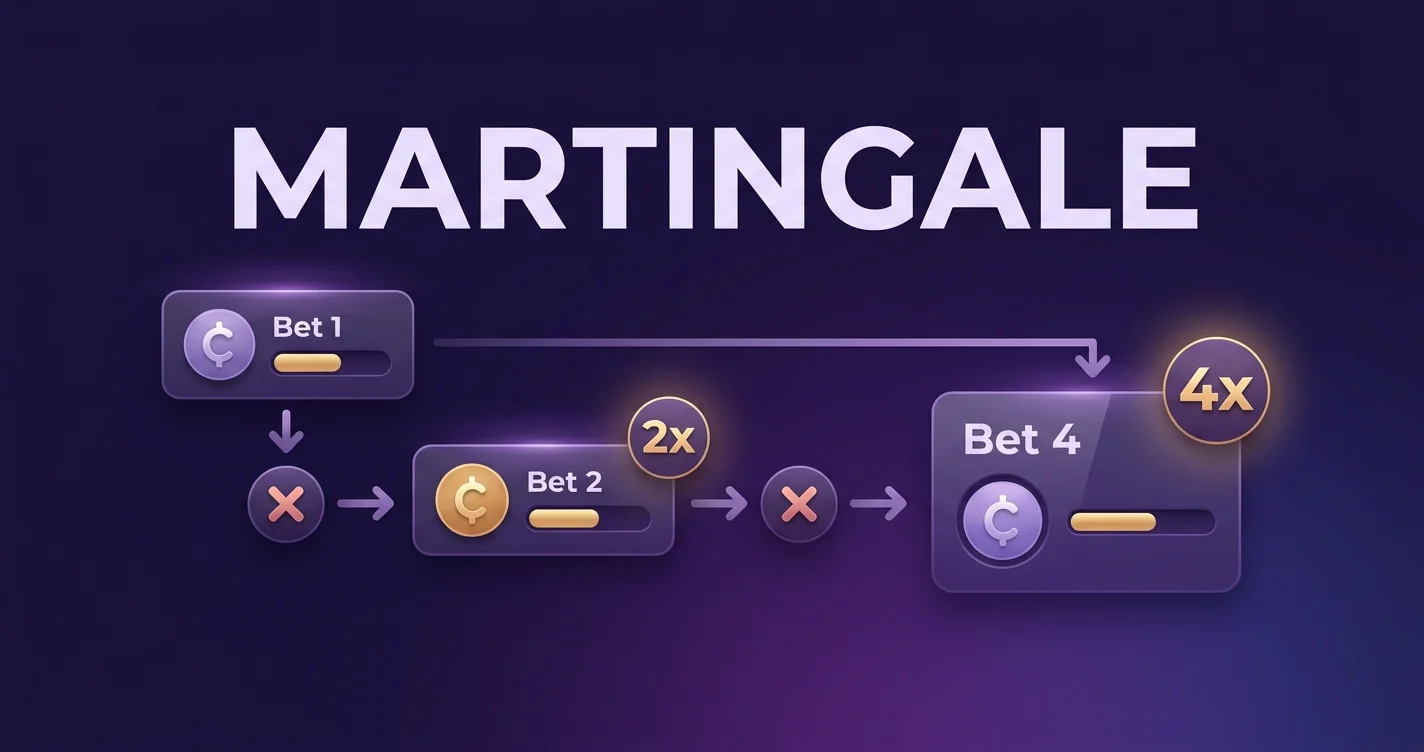
One of the best-known practical consequences of this fallacy is systems like the Martingale: after each loss you double the stake, "because it's bound to land eventually."
A simple calculation. The starting bet is 100 UAH on a color, and each loss means doubling:
- bet 1: 100 UAH;
- bet 2: 200 UAH;
- bet 3: 400 UAH;
- bet 4: 800 UAH;
- bet 5: 1,600 UAH.
In total, five losses in a row would cost 3,100 UAH. The chance of losing a color bet five times in a row in European roulette is about 3.6%. That sounds rare, but it's far from "impossible." When such a streak happens, you're risking an amount many times larger than your initial stake in order to win just 100 UAH.
You may run out of funds, or hit the table's bet limit, before the "eventually" arrives. And most importantly: the casino's edge doesn't disappear with such a system. You're just trading many small wins for a rare but very large loss. That's why it makes sense to set your own bankroll in advance and not adjust your bet size to previous results.
Common myths
- "After a streak of reds, black is closer." No, the odds don't change.
- "The slot hasn't given a bonus for a long time, it has built one up." For an ordinary RNG slot, that's not the case. Every spin is counted separately.
- "If you lose for long enough, you're bound to win afterward." A long losing streak is not an advance on future wins.
- "Statistics from the last 50 spins will help predict the next one." They describe the past, not the future.
- "I know it's a fallacy, so it doesn't affect me." In practice, knowing the theory doesn't always help when emotions and real money are involved. It's useful to have simple rules set in advance.
When the past really does matter
Not all games are the same. There are situations where previous events genuinely change the odds:
- in a card game without reshuffling the deck, cards already dealt affect the composition of what remains (card counters exploit this, which is a completely different topic from the gambler's fallacy);
- some in-game bonus mechanics have counters or accumulating elements, but these are written into the game's rules and don't depend on your "feeling";
- in skill games such as poker, your decisions and information about opponents matter.
If the game's rules don't describe such a mechanism, it's safer to assume that each round is independent.
How this affects your decisions
Knowing about the gambler's fallacy is above all useful in practice. A few simple rules:
- Don't change your bet because of a streak. Neither raising it "because it's time" nor lowering it "because it's not going well" makes mathematical sense. Your bet size should depend on your budget.
- Set a limit before you play. It's best to decide in advance the amount and time you're prepared to spend, while your head is cool.
- Don't chase losses. The thought "I have to win it back, it's due now" is a direct consequence of this fallacy.
- Distinguish entertainment from a system. If you play for fun, it's fine to spend a planned amount. If you're looking for a "scheme that guarantees" wins, that's a signal to stop.
- Take breaks. After a long run of losses or, conversely, a big win, it's worth stepping away from the game for a few minutes.
Responsible gambling
The gambler's fallacy is dangerous because it looks logical. It pushes you to raise your bets exactly when you're least protected against losses. No "streak" or "system" guarantees a win, and any game played with money carries the risk of losing it. You must be 18 or older to play.
If you notice that you're playing longer or for larger amounts than you planned, that's a reason to stop. At RichTop you can set limits on yourself: self-exclusion is available for a period from 6 months to 5 years, along with tips on controlling your play.
Summary
The gambler's fallacy is the belief that randomness "corrects" itself. In independent games, it doesn't. A streak of red, a slot without a bonus or a run of small multipliers doesn't increase the chance of the opposite result. The best protection is a budget set in advance, calm bets and the understanding that every round starts with a clean slate.






 Google

 Payment History