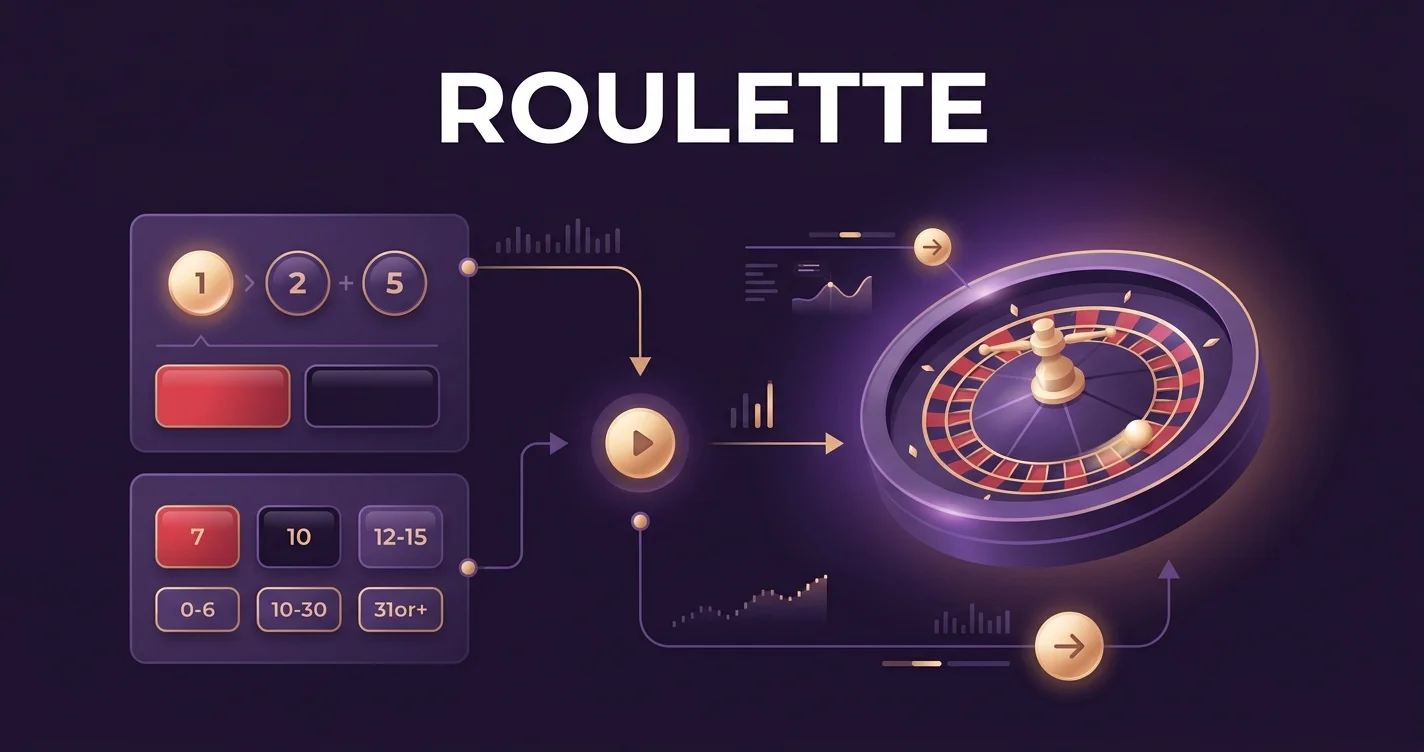
Roulette is a table gambling game in which players bet on which pocket of the wheel the ball will land in. The wheel has numbered sections, and the payout depends on how unlikely the bet was. The result of each spin is random, and the casino's edge is built into the rules of the game itself.
How roulette is set up
The game is built around a wheel with pockets and a table with a betting layout. The croupier launches the ball in one direction while the wheel spins in the other. Bets are accepted while the ball is still rolling. Then the ball settles in one of the pockets, the winning number is announced, and all bets are settled.
Each spin is independent of the previous ones. The wheel has no memory of what came up before, so "streaks" and "patterns" have no influence on it.
Three main wheel variants
- European roulette: 37 pockets, numbers 1 to 36 and a single zero.
- American roulette: 38 pockets, with a zero and a double zero.
- French roulette: the same wheel as the European one, but with extra rules that are often more favorable to the player (more on this below).
A difference of one pocket seems minor, but it doubles the casino's edge. This is the main practical takeaway from this article.
Bet types and payouts
Bets are divided into inside bets (on specific numbers) and outside bets (on large groups of numbers). The more numbers a bet covers, the more often it wins, but the lower the payout.
| Bet | Numbers covered | Payout | Probability (European) |
|---|---|---|---|
| Single number (straight) | 1 | 35 to 1 | 1/37, about 2.70% |
| Split | 2 | 17 to 1 | about 5.41% |
| Street | 3 | 11 to 1 | about 8.11% |
| Corner | 4 | 8 to 1 | about 10.81% |
| Six line | 6 | 5 to 1 | about 16.22% |
| Dozen or column | 12 | 2 to 1 | about 32.43% |
| Red/black, even/odd, 1-18/19-36 | 18 | 1 to 1 | 18/37, about 48.65% |
Zero is neither red nor black, neither even nor odd. That is why a bet on "red" wins slightly less often than 50% of the time.
Where the casino's edge comes from
If payouts were fair, a single-number bet would pay 36 to 1: the wheel has 37 pockets, but one of them is zero. In reality it pays 35 to 1. That difference is the casino's edge (house edge).
- European roulette: 1/37, or about 2.70%.
- American roulette: 2/38, or about 5.26%.
- French roulette with the rule of returning half the stake when zero comes up (La Partage) on 1-to-1 bets: about 1.35%.
An important point: the edge is the same for every type of bet. A bet on a single number, on red or on a dozen has exactly the same expected value. Only the nature of the play changes: rare big wins or frequent small ones.
Calculation example
Take European roulette and a bet of UAH 100.
A bet on red. A win comes with probability 18/37 (about 48.65%) and brings a net profit of UAH 100. A loss comes with probability 19/37 (about 51.35%) and costs UAH 100. The average result per spin: 100 × 18/37 - 100 × 19/37 = minus UAH 2.70.
A bet on a single number. With probability 1/37 you receive a profit of UAH 3,500, and with probability 36/37 you lose UAH 100. The average result: 3,500 / 37 - 100 × 36/37 = approximately 94.59 - 97.30 = minus UAH 2.70.
Both bets "cost" the same on average: UAH 2.70 per UAH 100. If you place 200 bets of UAH 100 over an evening (a turnover of UAH 20,000), the expected loss is roughly UAH 540. The actual result of a short session can differ greatly in either direction, but over the long run it converges toward the math.
Live roulette and RNG roulette
Online casinos offer two fundamentally different formats.
Virtual roulette
The wheel is animated, and the result is determined by a random number generator (RNG). The game is fast, bets can be placed without pauses, and low minimum stakes are often available.
Live roulette
A real wheel in a studio, a live dealer and a video stream. The result is determined by a physical ball, and you place bets through an on-screen interface. There is a betting timer, a chat and sometimes several cameras. The pace is slower: one spin takes noticeably longer than in the virtual version.
Mathematically, with the same wheel rules, both formats are equivalent. Live simply gives a different feel to the game, while the virtual version burns through a bankroll faster because of the greater number of spins per hour. Live games are also in the RichTop catalog, so the choice of format depends on which pace is comfortable for you.
Roulettes with extra multipliers
There are versions in which random multipliers are added to individual numbers in a regular game. Single-number wins can be higher, but this is usually paid for with reduced payouts on other bets. Before playing, it is worth reading the rules and calculating the casino's edge in that variant. It may be higher than in classic European roulette.
Common mistakes and myths
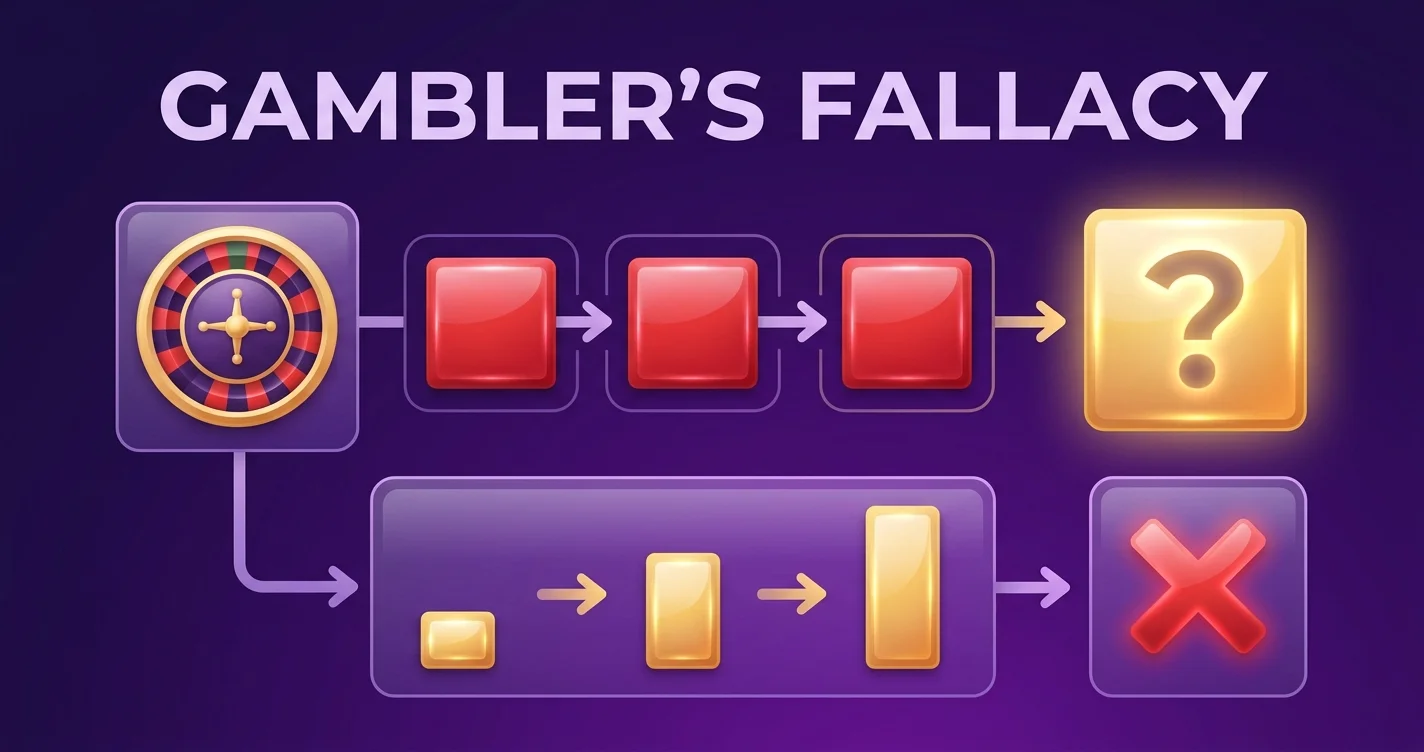
"Red has come up seven times, so black is definitely next"
This is the gambler's fallacy. The ball does not know about previous results. The probability of red on the next spin is the same as before the first one.
"There's a number that hasn't come up for a long time, so it's "due""
The same applies here. "Hot" and "cold" numbers on the statistics screen are interesting to look at, but they do not help predict the next result.
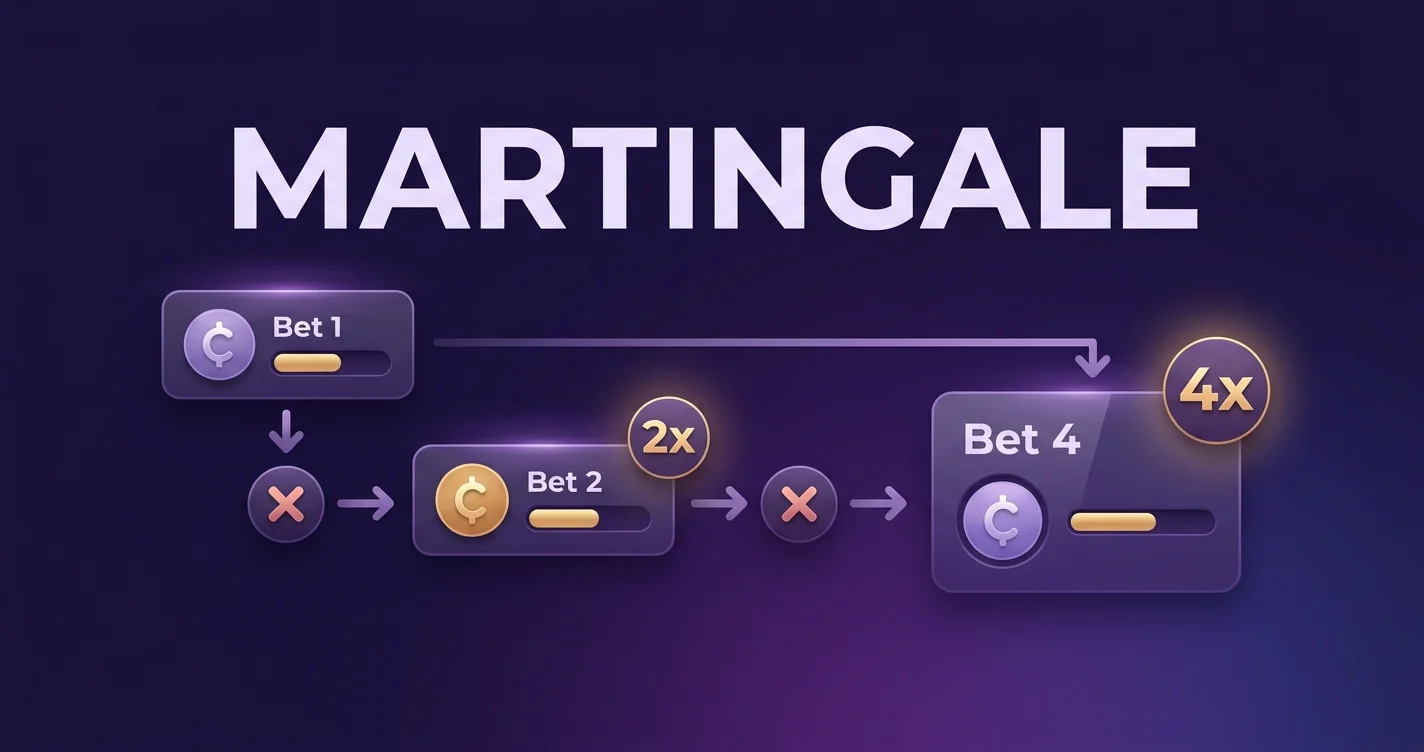
"The Martingale system guarantees a profit"
The idea is simple: after a loss, double the bet so that the first win covers all losses. The problem is that bets grow exponentially, while money and table limits are finite.
Example: a starting bet of UAH 20 and a balance of UAH 1,000. The bets are: 20, 40, 80, 160, 320. After five losses in a row you have already spent UAH 620, and the sixth bet would have to be UAH 640, which you can't afford. The probability of five losses in a row on red is about 3.6%. That is not rare, but a quite typical event over a few dozen series. One such episode wipes out dozens of small UAH 20 wins. On top of that, the table has a maximum bet, so you can't double endlessly.
"If you bet on the whole layout, you can't lose"
Covering almost the entire layout does not remove the casino's edge. You simply distribute your bets so that zero takes its share, and the total of the remaining payouts is lower than your overall stake.
"There's a system that beats the wheel"
Progressions (Martingale, D'Alembert, Fibonacci and others) only change the distribution of wins and losses over time: small wins more often, a big collapse occasionally. They do not change the expected value, because each spin has a negative expectation, and a sum of negative expectations does not become positive.
How this affects a player's choice
- Choose the European or French wheel. American roulette with its double zero costs you twice as much at the same stake.
- Look for La Partage or En Prison rules. They reduce losses on zero for 1-to-1 bets. The terms are always described in the rules of a specific table.
- Don't confuse risk and chance. A single-number bet has the same casino edge as a bet on a color, but produces much bigger swings in results.
- Set a limit in advance. Your bankroll should be an amount you are ready to spend on entertainment without harming your budget. Divide it into sessions and bets so that it lasts for a sufficient number of spins.
- Count turnover, not just the stake. The faster the pace of play, the more spins per hour and the greater the expected loss. Virtual roulette with automatic spins "eats" money faster than live.
Roulette and bonuses
At Rich Top, as at any online casino, a wagering requirement applies to bonuses, and the rules may count different types of games differently. Before playing roulette with an active bonus, read the terms: whether bets on table games count, at what rate, and whether any bet types are prohibited. Otherwise you can burn through your bonus balance without making progress on wagering, or break the rules and complicate withdrawals. If you play for entertainment rather than to meet wagering, it is better not to take an active bonus.
Responsible gaming
Roulette is simple and fast, so it is easy to lose track of time and money. You may play only from the age of 18. Do not top up your account to "win back" a loss, and do not regard gambling as a way to make money. Set a time and amount limit before the session begins and stop when it is reached. If you feel that the game is getting out of control, Rich Top offers self-exclusion for a period from 6 months to 5 years, and you can also contact specialized support organizations.
In short
- Roulette is a game with a fixed casino edge: 2.70% in the European version and 5.26% in the American one.
- All bet types have the same expected value; only the spread of results differs.
- Previous results do not affect the next ones, and progressions do not create an advantage.
- The best choice for a player is a European or French wheel, moderate stakes and a limit set in advance.





 Google

 Payment History