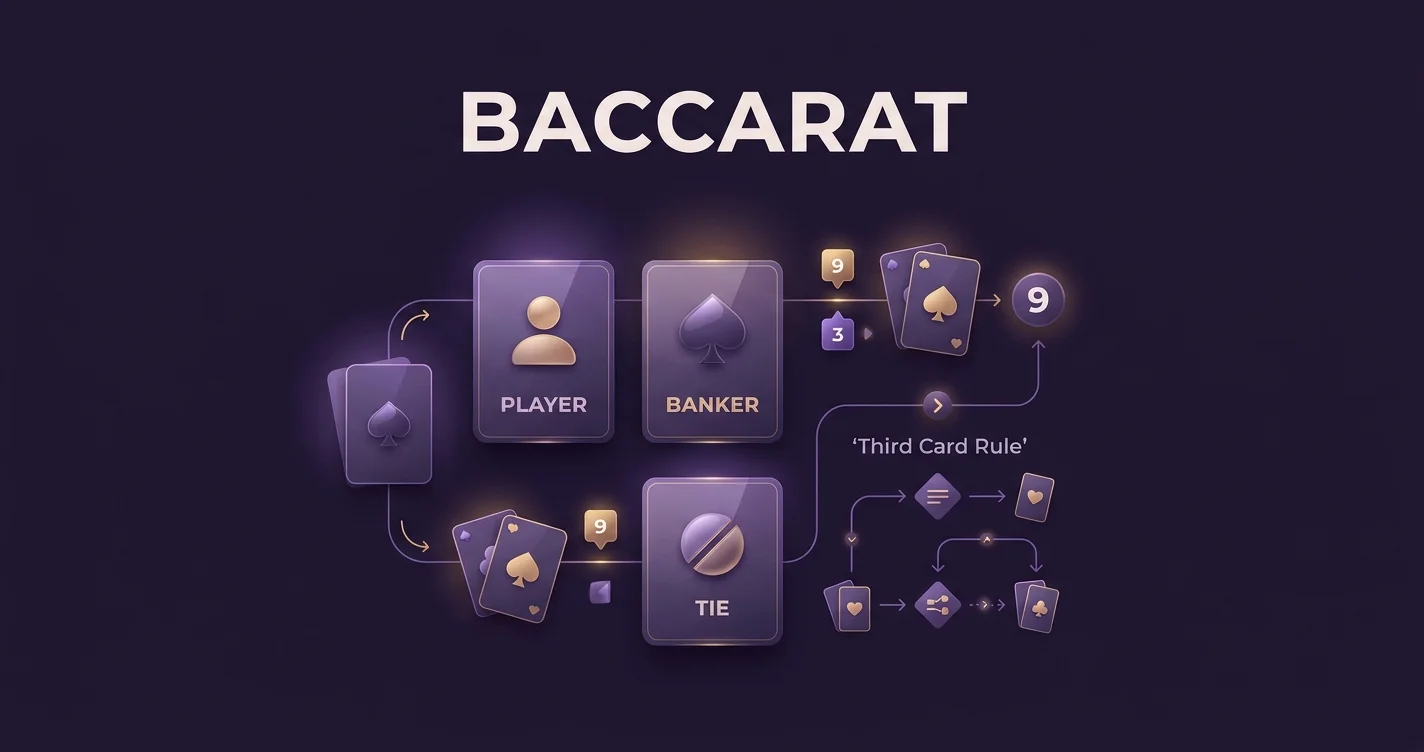
Baccarat is a card game against the banker where you have to guess whose hand will finish closer to 9 points: the player's (Player) or the banker's (Banker), or whether the result will be a tie (Tie). Casinos most often offer the "punto banco" variant: cards are dealt by fixed rules, and the player makes no decisions during the hand. All you decide is what to bet on and how much.
How the game works
The game is usually played with eight decks of 52 cards. The dealer deals two cards each to the Player hand and the Banker hand. The names are only labels: a bet on the "banker" doesn't mean you're playing for the casino, and a bet on the "player" doesn't mean the cards are yours. These are simply two hands, and you place a bet on one of them.
Card values
- Cards from 2 to 9 are worth their face value.
- Tens and face cards (J, Q, K) are worth 0.
- An ace is worth 1 point.
A hand's points are calculated like this: add up the card values and drop the tens, keeping only the last digit. For example, 7 + 8 = 15, so the hand has 5 points. The maximum is 9.
Three betting options
- Player: wins if the player's hand is closer to 9. Pays 1 to 1.
- Banker: wins if the banker's hand is closer to 9. Pays 1 to 1, but with a casino commission, usually 5% of the winnings.
- Tie: a bet that both hands will finish with equal points. Usually pays 8 to 1.
If you bet on Player or Banker and the hand ends in a tie, your stake is usually returned (a push). Rules can differ slightly, so check the information in the game itself.
When the third card is drawn
This is the only part where beginners get confused, though you don't need to memorize it: the dealer does everything automatically according to the table.
- If either hand has 8 or 9 points after two cards (a "natural"), the hand ends immediately.
- The player's hand draws a third card on 0-5 points and stands on 6-7.
- The banker's hand depends on whether the player drew a third card.
| Banker's points after two cards | When the banker draws a third card (if the player drew one) |
|---|---|
| 0, 1, 2 | Always |
| 3 | Always, except when the player's third card is an 8 |
| 4 | If the player's third card is from 2 to 7 |
| 5 | If the player's third card is from 4 to 7 |
| 6 | If the player's third card is a 6 or 7 |
| 7 | Never |
If the player didn't draw a third card, the banker's rule is just as simple: draw on 0-5 points and stand on 6-7.
An example of one hand
Suppose you bet 100 UAH on Player. The dealer deals:
- Player: a king (0) and a five (5), 5 points in total.
- Banker: a four and a two, 6 points in total.
The player has 5 points, so he draws a third card. It's a three, and the player's hand now has 8 points. The banker has 6 points. According to the table, the banker draws only if the player's third card is a 6 or 7, but here it was a three, so the banker stands. Result: 8 against 6, and Player wins. You receive 100 UAH in winnings plus your stake back.
If you had bet the same 100 UAH on Banker and the banker had won, you would have received 95 UAH in winnings, because the casino takes a 5% commission. If you had bet on Tie and the cards came out 6 and 6, the payout would have been 800 UAH. But a tie comes up far less often.
Probabilities and the casino's edge
Because the rules are fixed, the math of baccarat is well known. Roughly: the banker's hand wins in 45.9% of hands, the player's hand in 44.6%, and a tie comes up in about 9.5%. That is why the banker gets a small advantage, and the casino takes a commission from its winnings to even out the odds.
The resulting house edge under standard rules is approximately as follows:
| Bet | House edge | Average loss per 1,000 UAH wagered |
|---|---|---|
| Banker (5% commission) | about 1.06% | about 10.6 UAH |
| Player | about 1.24% | about 12.4 UAH |
| Tie (pays 8 to 1) | about 14.36% | about 143.6 UAH |
These are averages over a very large number of hands, not a forecast for your session. In a short game you can win or lose far more than the average. But the comparison shows the main point: bets on Banker and Player are many times cheaper for the player than a bet on Tie. The high payout on a tie looks attractive, but mathematically it is the worst option.
Some tables offer a no-commission variant: the banker wins without a deduction, but if he wins with 6 points, the payout is reduced. The house edge there is slightly higher than on a standard Banker bet. Certain side bets (for example, on a pair of identical cards) usually cost even more. Check the rules of the specific table before you play.
Baccarat in live format
Online baccarat is played in two formats. The first is a virtual game where the cards are dealt by a random number generator. The second is the live casino: a real dealer, real cards, and a stream from a studio. The rules and the math are the same in both formats; what differs is the atmosphere, the pace, and the chance to chat with others.
In the live version a hand takes about a minute, and there is time to place a bet, so the pace is calmer than in slots. That doesn't make the game safer: you make fewer bets per hour, but each bet can be large. The minimum and maximum bets at the table are shown in the interface.
Common mistakes and myths
"Roads" and patterns predict the result
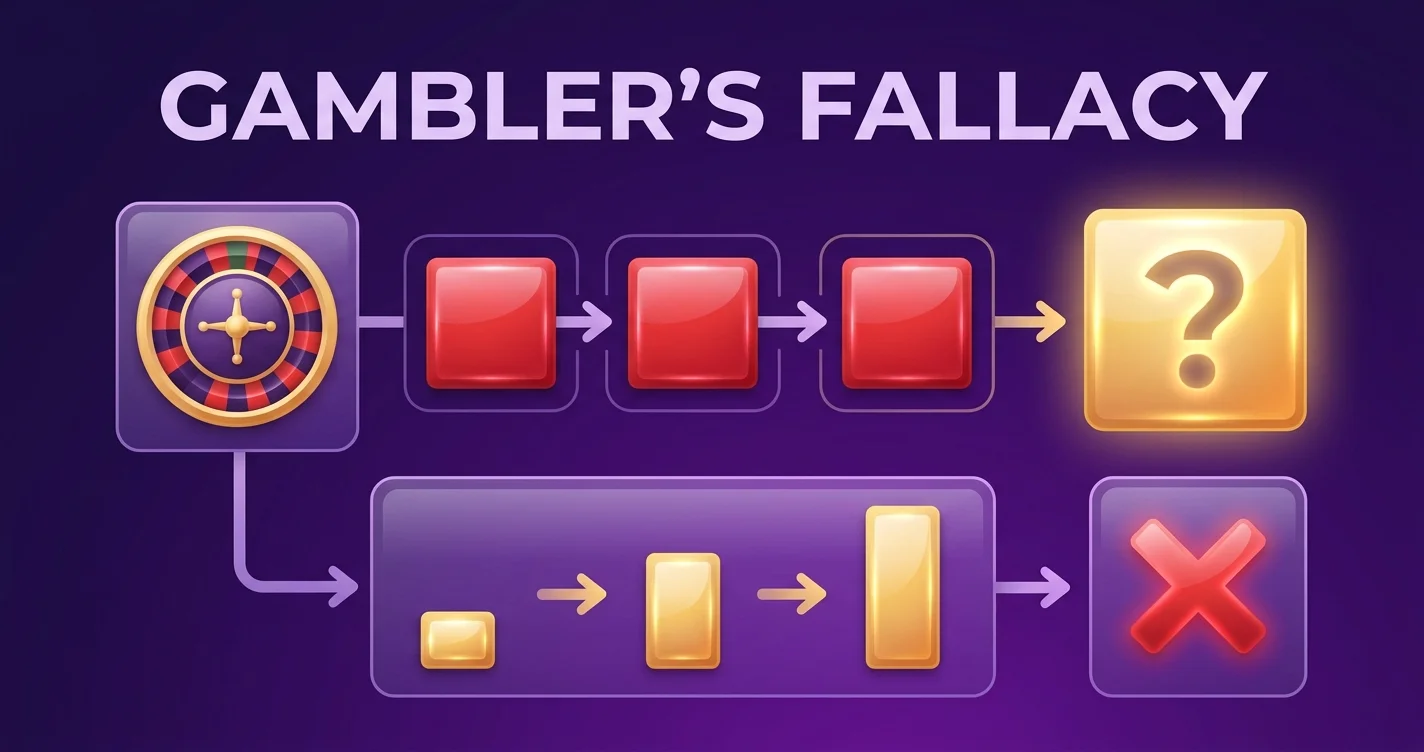
History tables are displayed next to the table: streaks of banker wins, alternating hands, and so on. They help you track the course of the game but don't predict the next hand. Cards don't remember what happened before. A streak of six banker wins doesn't make a player win "more likely."
Progressions save you from losing
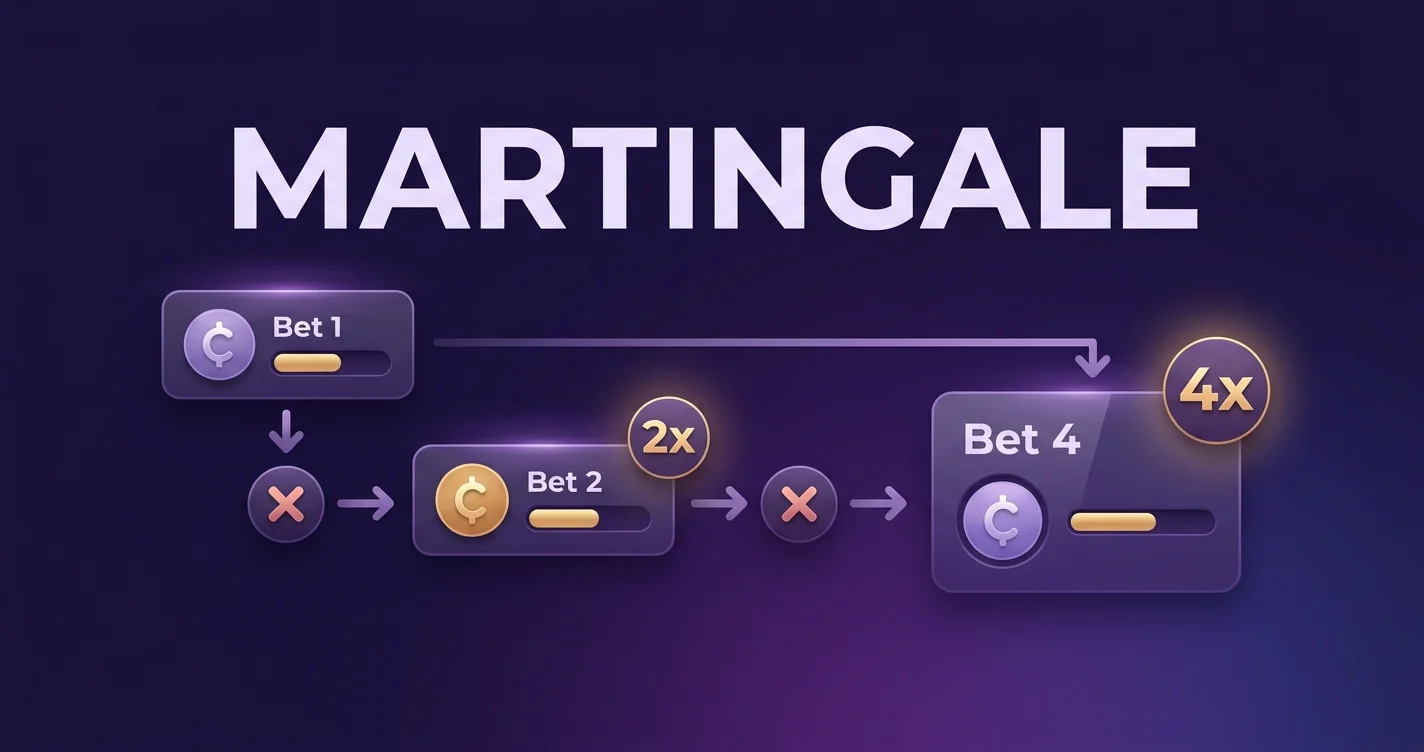
Systems such as doubling your bet after a loss change the size of your bets, not the casino's edge. Quite often one long losing streak eats the entire balance or runs into the table limit. The mathematical expectation remains negative.
A Tie bet "will definitely hit sooner or later"
The 8 to 1 payout seems generous, but a tie occurs less often than the payout would need to be fair. Playing Tie over the long run costs the most.
The banker always wins, so he should always be chosen
The banker really does win slightly more often, and that is exactly why his bet has a lower house edge. But a win is not guaranteed, and the 5% commission reduces your profit. It is the "cheapest" bet, not a "can't-lose" one.
Any bonus automatically works for baccarat
That's not so. At many casinos, table and live games count toward the wagering requirement only partially or not at all. So before you try to clear a bonus with baccarat, read the bonus terms. This is especially important if you plan to withdraw funds before the wagering is complete.
How baccarat affects your decisions
- Choosing a bet. If you want to reduce the cost of play, stick to Banker or Player. Tie is better treated as entertainment with a high price.
- Pace and limits. Decide the session budget and the size of a single bet in advance. It helps to base this on your bankroll: one bet should be a small part of the amount you are prepared to spend on entertainment.
- Expectations. A low house edge means the game is "cheap" over the long run, but it doesn't mean you'll be ahead. Baccarat is entertainment with a negative expectation, like any gambling game.
- Bonuses. Check whether live games count toward wagering. If they don't, bets in baccarat may not move you closer to withdrawal.
If you play at RichTop, it offers live games, and it's best to read the betting and bonus rules in the site's sections before you start a session. For anything concerning wagering in specific games, see the bonus terms. As a reminder, you can play only from the age of 18.
Responsible gambling
Fast series of hands and the feeling that you're "about to win it back" encourage you to raise your bets. Set a time and money limit before you start playing, and don't top up your account to recover losses. If you feel the game is getting out of control, at Rich Top you can use self-exclusion for a period from 6 months to 5 years. It is available in the limits section of the site, and tips on controlling your play are collected there as well.
In brief
- Baccarat is a game of guessing whose hand is closer to 9: Player, Banker, or Tie.
- There are no decisions during the hand; the dealer draws the third card according to the table.
- The lowest house edge is on the Banker bet (about 1.06%), followed by Player (about 1.24%).
- Tie offers a big payout but has a house edge of over 14%.
- Betting systems and "roads" don't change the math of the game.
- Before playing with a bonus, check whether baccarat counts toward wagering.
Knowing these basics, you can play with awareness: understand what you're paying for and not expect more from the game than it can give. If you want to try the live format rather than the digital one, Rich Top offers live games, and it's worth choosing the table and bet limits so that entertainment stays entertainment.





 Google

 Payment History